
Industry-Based SEO Services for Businesses Competing in Specialized Markets
SEO · AEO · GEO · AI Search Specialist
A local home services company, a B2B software platform, and a niche ecommerce retailer can follow identical SEO advice and get three different outcomes, because they aren’t competing in the same search environment. The results page looks different, the buyer’s research looks different, and what counts as convincing proof looks different. One generic framework usually means over-investing in tactics that don’t move the needle for a specific market, and under-investing in the ones that do.
I’m Partho Saha, an SEO consultant. My Industry-Based SEO service starts by understanding how your market actually searches, compares, and decides, then builds strategy around that reality.
Challenges
Where Generic SEO Assumptions Break Down
Search results are structured differently by category:
A local business competes against a map pack and reviews; a B2B software company competes against comparison articles; a niche retailer competes against marketplace listings. “Rank for keywords” ignores that the result mix isn’t the same.
Buyer research and sales cycles differ by purchase type:
Low-cost, low-risk decisions convert off a handful of trust signals. Higher-cost or higher-risk ones involve longer comparison and often more than one decision-maker.
What counts as proof changes by category:
reviews and response time for local services, case studies and security documentation for software, credentials and process clarity where the purchase carries real risk.
The real competitive set is often not who a business assumes:
A regional service business may be losing visibility to national directories, not the company down the street and strategy built against the wrong competitor solves the wrong problem.
Solution
What Industry-Based SEO Actually Services Solves
Industry-Based SEO adjusts keyword targeting, content depth, trust signals, and competitive analysis to match how a specific market actually searches and buys, rather than applying one generic approach everywhere. A strategy that looks correct on a checklist can still underperform if it’s calibrated to the wrong buyer behavior or competitive set.
This isn’t a new discipline layered on top of technical, local, or content SEO it determines how much emphasis each should get for your specific market, and in what order. It doesn’t guarantee rankings, and it doesn’t replace category-specific execution work like catalog architecture or citation building.
What I Do
What My Industry-Based SEO Service Includes
Market and Competitive-Set Research
I identify who is actually winning visibility in your category not just the businesses you consider direct competitors, but directories, marketplaces, and publishers that may be capturing demand first. This often reshapes the target list entirely.
Buyer Journey and Search Intent Mapping
I map how someone in your market moves from noticing a problem to choosing a provider, and what drives that decision. This sets whether the priority is fast, high-intent capture or longer comparison content.
Vertical Keyword and Query Research
Buyers describe problems differently by category plain and urgent for a homeowner, specification-led for a procurement team, feature-led for a niche consumer. I research the terms specific to how your buyers actually search.
Trust-Signal and Proof Calibration
I review what your category’s buyers need to see before they trust a provider’s reviews, credentials, case studies, pricing transparency and where it’s missing. Where a purchase carries real risk to a client’s finances, health, or legal standing, I flag where a qualified professional’s review is appropriate; SEO doesn’t substitute for compliance review.
Content Depth and Format Strategy
Some categories reward short, fast-answer content; others need longer pages for a slower research process. I set the right depth for your category, and flag where an issue belongs elsewhere: a catalog problem to Ecommerce SEO, a location problem to Local SEO rather than duplicating a specialist page.
Research First
How I Research and Diagnose the Opportunity
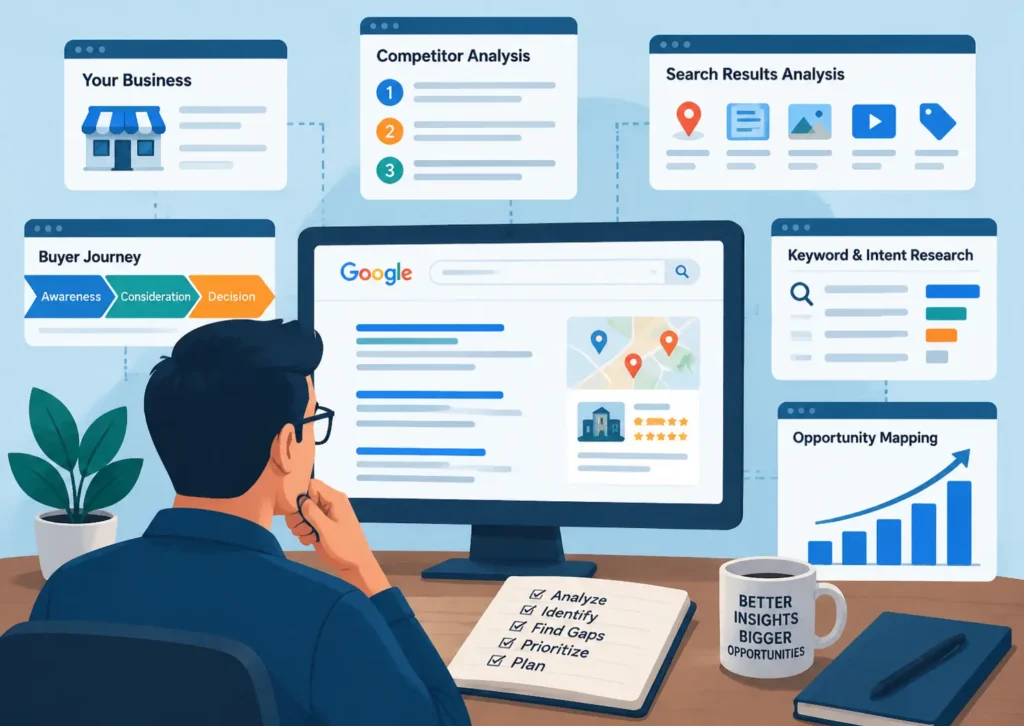
Recommendations start with evidence from your specific market, not a pre-built vertical template.
I begin with your business model and who actually buys from you, then examine the real search results for your priority terms: what result types appear, who occupies them, and what those pages have in common. Where Search Console or existing rankings are available, I use them to see what’s already working. I also review your genuine competitive set, which is often broader than the businesses you’d name as rivals.
This isn’t a checklist. A tactic essential in one industry extensive review generation, for example may matter far less in another. Priorities follow what the evidence shows, weighed against business impact and what’s realistic to implement.
CORE SPECIALISMS
SKILLS & EXPERTISE
Proven across 3+ years and 50+ successful projects
These are the areas where I deliver my deepest expertise and most consistent results for clients worldwide.
AEO
GEO
AI SEARCH
AIO
CHATGPT RANKING
KEYWORD RESEARCH
TECHNICAL SEO
LINK BUILDING
SHOPIFY SEO
CONTENT STRATEGY
LOCAL SEOO
ON-PAGE SEO
VOICE SEARCH
GOOGLE SGE
SAAS SEO
E-COMMERCE SEO
COMPETITOR ANALYSIS
SITE ARCHITECTURE
CORE WEB VITALS
INTERNATIONAL SEO
Roadmap
How the Industry-Based SEO Services Engagement Works
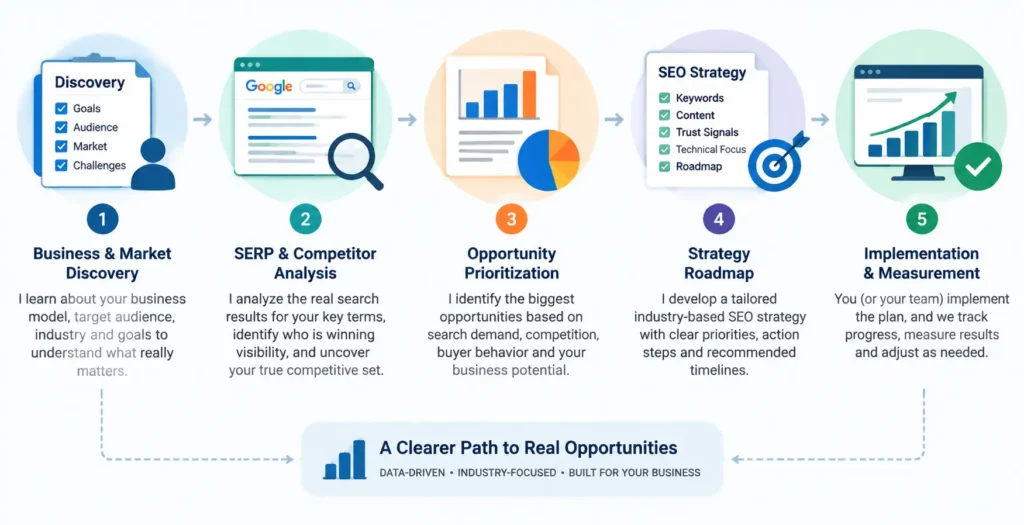
Business and Market Discovery
I review your business model, target buyers, and current SEO performance to understand the market you’re operating in.
SERP and Competitor Diagnosis
I examine the real results for your priority terms and identify who’s winning that visibility, and why.
Opportunity Prioritization
Findings are ranked by business impact, search opportunity, and effort.
Strategy and Roadmap
Recommendations are sequenced to reflect your market’s buyer behavior and trust expectations, not a generic order of operations
Implementation Planning and Measurement
I define what to track for your category, since useful signals can differ from a generic traffic report.
Execution
How Recommendations Become Website Changes
The work process describes how the engagement moves forward. Execution is how findings become changes on your site.
I translate strategy into content briefs calibrated to what your category’s buyers expect: depth, proof points, and level of technical detail. Where the work touches technical structure, catalog architecture, or location pages, I hand it to the relevant discipline rather than treating it as generic industry work. I can coordinate directly with your team or developer, and I review results after changes go live to confirm they’re moving the metrics that matter for your market.
WHY PARTHO
Why Work With Partho Saha for Industry-Based SEO Services
Research Before a Template. I don’t keep a fixed playbook per industry. Every engagement starts by re-examining the actual results, buyer behavior, and competitive set for that business.
Business Priority Before Category Assumptions. What’s standard for a category isn’t automatically a priority for the specific business inside it.
Honest About Scope. I’m an individual consultant, not an agency with dedicated staff for every vertical. Where content carries real regulatory weight, I work alongside your own compliance review rather than replacing it.
Implementation-Aware. Recommendations account for what your team can realistically execute and hold up for both traditional search and AI-assisted discovery, without promising AI citations any service can’t guarantee.

RESULTS
Outcomes Industry Based SEO Can Support
Industry-based SEO isn’t just about applying the standard playbook for your category. The real value comes from building a strategy calibrated to how your specific market actually searches, competes, and earns trust.
Visibility better matched to how your buyers actually search
Content and proof points calibrated to what your category expects before converting
A more accurate view of who you’re really competing against
Reduced effort on tactics that matter more in other industries than yours
A prioritized roadmap instead of a generic task list
SEO performance depends on competition, market conditions, and execution. No service can guarantee rankings, traffic, or AI citations, but strategy calibrated to your actual market creates a stronger foundation than a one-size-fits-all approach.
"Traffic means nothing if it doesn’t convert. Rankings mean nothing if they don’t bring revenue."
Industry-Based SEO FAQs
What does Industry-Based SEO include?
Market and competitor research, buyer journey mapping, vertical keyword research, trust-signal review, and a prioritization strategy built around how your category searches and buys.
How is this different from Local SEO or Ecommerce SEO?
Those handle execution for geography-bound and catalog-based businesses. This decides how much emphasis they should get for your market, then hands off execution accordingly.
How do you research a market you haven't worked in before?
The same way I’d research any market by examining the real results and who’s actually winning visibility. Unfamiliarity means more research, not a generic template.
Do you work with regulated industries like healthcare, legal, or finance?
I support SEO and content strategy for these categories, but I’m not a substitute for compliance review regulatory claims should go through your own qualified reviewer.
Is this a one-time project or ongoing?
Either. A focused engagement sets the strategy and priorities; ongoing work helps as competitors and your business change.
Will you implement the recommendations, or only advise?
Both I provide implementation-ready briefs, and can coordinate directly on execution where useful.
Get Started
Review Your Industry's Search Opportunity
If your SEO results haven’t matched the effort going into them, the issue may not be execution, it may be a strategy built for a different kind of market. I can review your business, your real competitors, and how your buyers actually search, then identify where a generic approach might be working against you.
Save this page and reach out when you’re ready to build an SEO strategy calibrated to how your specific market actually searches, competes, and converts.