



GET YOUR FREE ECOMMERCE SEO AUDIT
Find out exactly why your product and category pages are not ranking -and what it will take to fix them. No obligation.
Ecommerce SEO Services That Turn Product and Category Pages Into Buying-Intent Traffic
SEO · AEO · GEO · AI Search Specialist
Every product you add is a page search engines must discover, understand, and decide whether to rank. As a catalog grows, that decision gets harder for a store to win on its own.
I’m Partho Saha, an SEO consultant. My Ecommerce SEO service reviews how your product pages, category structure, technical foundation, and content work together, then prioritizes what is actually limiting organic visibility and buying-intent traffic.
Where It Fails
Where Ecommerce Sites Lose Search Visibility as the Catalog Grows
Most ecommerce SEO problems surface as the catalog scales, not on day one.
Filter and sort options on category pages can generate thousands of crawlable URL combinations for color, size, and price and search engines spend crawl budget there instead of new products, delaying indexation of pages that drive revenue.
Product variants often create near-duplicate URLs that split ranking signals, and discontinued products removed without redirects lose accumulated relevance. Thin category pages, built mainly to hold product grids, struggle to rank for broader searches.
Platform constraints add another layer: Shopify’s fixed URL structure and app bloat can slow load times, while WooCommerce and Magento carry their own template-level risks.
What It Solves
What Ecommerce SEO Actually Solves
Ecommerce SEO is the process of making product, category, and collection pages easier for search engines and AI-driven shopping tools to crawl, understand, and rank for the terms buyers actually use so the store earns qualified traffic without relying entirely on paid ads.
That matters because organic visibility compounds, continuing to rank and convert long after a campaign budget runs out.
What I Optimize
What My Ecommerce SEO Service Includes
Site Architecture and Category Structure
I review how categories, subcategories, and filters are organized and linked. Where faceted URLs create index bloat, I recommend canonical, noindex, or parameter rules based on which filter combinations carry real search demand.
Product Page Optimization
I assess titles, descriptions, structured data, and internal links at the template level, since thin or duplicated manufacturer copy is usually a pattern, not an isolated issue.
Technical SEO for the Catalog
Crawl efficiency, indexation, canonical conflicts, and redirect handling for discontinued products are reviewed at the platform level, since most ecommerce issues live in the theme, not a single page.
Content and Collection Strategy
I identify buying-intent and comparison searches your category pages aren’t yet capturing, and recommend content that supports both rankings and purchase decisions.
Structured Data and Shopping Visibility
Product schema and feed alignment are reviewed to support rich results and how product information is retrieved by AI-driven shopping tools.
Internal Linking & Navigation Optimization
I analyze how products, categories, collections, and supporting content connect across your store. Strategic internal linking helps search engines discover important pages, distributes authority across the catalog, and improves the path users take from discovery to purchase.
Conversion-Focused SEO Improvements
I review how search traffic moves through your ecommerce pages, identifying opportunities to improve category layouts, product information, trust signals, and user experience elements that help turn organic visitors into customers.
How I Research
How I Research the Opportunity
Recommendations start with evidence, not a fixed checklist.
I review Search Console and crawl data to see which product and category pages are indexed, ranking, or ignored, alongside keyword demand and competitor or marketplace visibility, since stores compete with Amazon as much as each other.
Where available, I also review revenue data by category, so priorities reflect what matters most to the business, not only the highest search volume. A crawl issue on a top-revenue category is addressed before a metadata gap on a low-traffic line.
CORE SPECIALISMS
SKILLS & EXPERTISE
Proven across 3+ years and 50+ successful projects
These are the areas where I deliver my deepest expertise and most consistent results for clients worldwide.
AEO
GEO
AI SEARCH
AIO
CHATGPT RANKING
KEYWORD RESEARCH
TECHNICAL SEO
LINK BUILDING
SHOPIFY SEO
CONTENT STRATEGY
LOCAL SEOO
ON-PAGE SEO
VOICE SEARCH
GOOGLE SGE
SAAS SEO
E-COMMERCE SEO
COMPETITOR ANALYSIS
SITE ARCHITECTURE
CORE WEB VITALS
INTERNATIONAL SEO
My Process
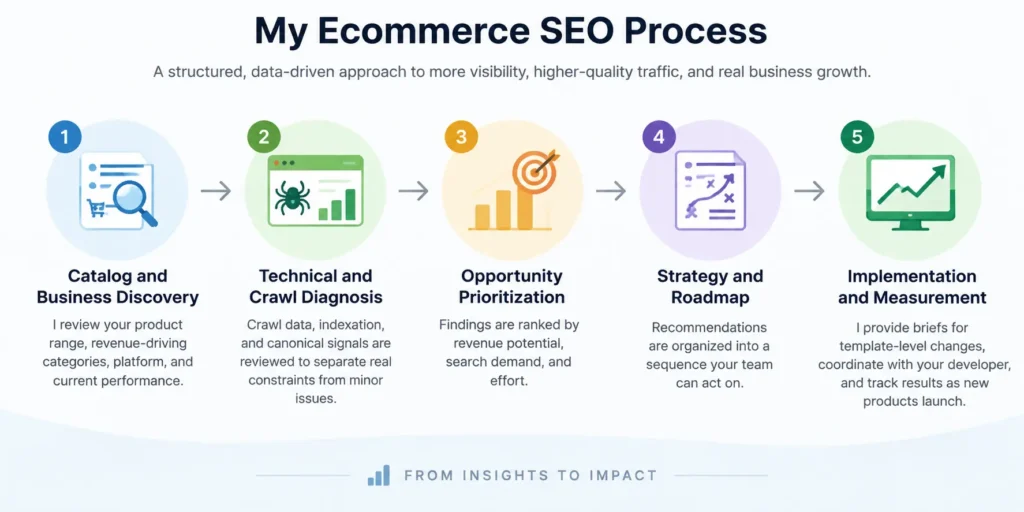
My Ecommerce SEO Process
Catalog and Business Discovery
I review your product range, revenue-driving categories, platform, and current performance.
Technical and Crawl Diagnosis
Crawl data, indexation, and canonical signals are reviewed to separate real constraints from minor issues.
Opportunity Prioritization
Findings are ranked by revenue potential, search demand, and effort.
Strategy and Roadmap
Recommendations are organized into a sequence your team can act on.
Implementation and Measurement
I provide briefs for template-level changes, coordinate with your developer, and track results as new products launch.
How I Execute
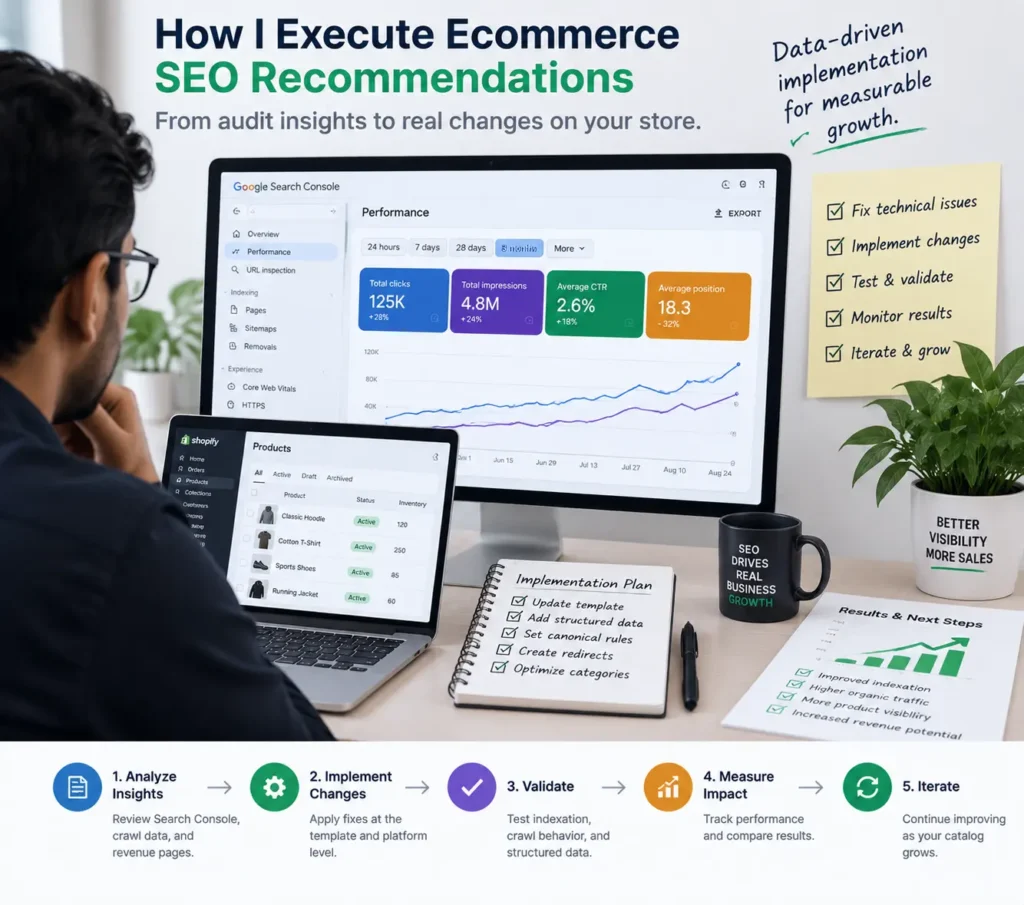
How I Execute Ecommerce SEO Recommendations
Work process describes how the engagement moves forward. Execution is how findings become live changes on the store.
Because most ecommerce SEO issues sit at the template level, I translate research into implementation briefs your developer can apply once, across every page that shares that template, rather than reworking pages individually. This may include theme-level canonical rules, structured-data implementation, redirect mapping, or category templates built for both filtering and content. Changes are validated after deployment to confirm indexation matches intent.
Why It Works
Why My Ecommerce SEO Approach Is Different
Research Before Recommendations
I diagnose crawl, indexation, and content data before proposing changes, so recommendations address the real constraint.
Revenue Priorities Before Vanity Rankings
Categories that drive revenue are prioritized ahead of pages that are easier to rank but contribute little to the business.
Template-Level Thinking
Because ecommerce sites run on repeating templates, I look for platform-wide fixes that scale across a growing catalog instead of one-off edits.
Search and AI Shopping Discovery Together
As buyers increasingly research products through AI-assisted search, I structure product and category information to remain useful for both traditional rankings and AI-driven retrieval.
RESULTS
What Ecommerce SEO Services Can Support
Ecommerce SEO is not only about fixing technical issues or optimizing individual product pages. The real value comes from building a scalable search foundation that helps your products, categories, and collections reach more qualified buyers.
Stronger Organic Visibility
Better Visibility for
Buying-Intent Searches
Improved Product &
Category Discoverability
Reduced SEO Risks
Across Your Store
More Efficient Crawling
and Indexation
Stronger Ecommerce
Content Authority
More Opportunities for Organic Sales
Better Visibility Across
AI Shopping Platforms
SEO performance depends on factors such as competition, website history, product demand, technical implementation, and ongoing optimization. While no SEO service can guarantee specific rankings or revenue outcomes, a research-driven ecommerce SEO strategy creates stronger opportunities for sustainable organic growth as your catalog expands.
WHY PARTHO
Why Choose Partho Saha For Ecommerce SEO Services?
I’m Partho Saha, an SEO consultant with hands-on experience in technical SEO, content strategy, and ecommerce optimization. My approach is built around research, data analysis, and scalable solutions rather than quick fixes.
Key Experience Highlights:
3+ Years of SEO Experience
50+ SEO Projects Completed
Technical SEO Expertise
Ecommerce SEO Understanding
Data-Driven Decision Making
HubSpot-Certified Digital Marketing Consultant
Research Before Recommendations
Proven SEO Methodology
Explore my technical and content SEO work through my case studies and learn more about my background on the about page.
"Traffic means nothing if it doesn’t convert. Rankings mean nothing if they don’t bring revenue."
Ecommerce SEO FAQs
What does Ecommerce SEO include?
Architecture review, product-page optimization, technical diagnosis, content strategy, and structured data, depending on catalog size and platform.
Who needs Ecommerce SEO?
Stores with growing catalogs, recent platform migrations, or stalled organic traffic despite adding new products.
Does the platform matter Shopify, WooCommerce, or Magento?
Yes. Each has different URL and template constraints, so recommendations are built around your platform.
Is this a one-time project or ongoing service?
Either. A focused project addresses priority issues; ongoing work helps as products and competitors change.
How does this affect AI shopping search?
Clear, structured product data makes it easier for AI tools to retrieve accurate information, though no service can guarantee AI citations.
Testimonials
What Clients Say
But don’t just take my word for it see what my clients have to say about the results and experience of working with me.

“Partho Saha is the real deal. His technical SEO audit uncovered critical issues that other agencies had missed for years. Our organic traffic has never been stronger.”
David Thompson

“What sets Partho apart is his ability to connect SEO strategy directly to business outcomes. Every recommendation was data-backed and actionable.”
Emily Johnson

“Partho’s strategic approach to SEO transformed our online visibility. We went from page 3 to dominating local search results in under six months.”
Michael Carter
Get Started
Review Your Ecommerce SEO Opportunities
If product pages are ranking below competitors or new collections launch without a clear SEO plan, I can review your catalog and build a prioritized roadmap.
Save this page and contact Partho Saha when you are ready to improve your ecommerce SEO, increase product visibility, strengthen your category structure, and attract more buying-intent traffic through search.