



Partho Saha

Semantic SEO Services for Topical Authority and Search Clarity

SEO · Technical · Content · Local · AI Search

Publishing more content does not automatically make a website easier to understand. Problems often come from structure: overlapping pages target the same intent, important topics are missing, commercial pages sit disconnected from supporting content, and internal links fail to show how subjects relate.

I’m Partho Saha, an SEO consultant providing Semantic SEO Services for businesses that need clearer content architecture, stronger topical relevance, and better-defined page roles. I use query ownership, entity relationships, topical mapping, SERP evidence, and prioritization to decide what a site should cover, how pages should connect, and what should be improved first.

Years Experience
0 +
Projects
0 +
Happy Clients
0 +
Client Satisfaction
0 %

REVIEW YOUR SEMANTIC SEO OPPORTUNITIES

Find out where overlap, missing topical coverage, weak internal relationships, or poor prioritization are limiting your site’s organic growth – and what it takes to build real topical authority. No obligation.

Core Challenge

Why Businesses Need Semantic SEO

Semantic SEO becomes important when the issue is bigger than one missing keyword. Common signs include:

  • multiple pages competing for closely related searches;
  • blogs attracting impressions without supporting commercial pages;
  • content clusters built around volume rather than business relevance;
  • gaps around important services or buyer questions;
  • internal links that do not reflect contextual relationships.

These problems persist when keyword research, content production, on-page optimization, and internal linking are handled separately. Semantic SEO connects those decisions around a defined role for each page.

Structural Solutions

What Semantic SEO Helps Solve

Semantic SEO helps organize a website around meaning, intent, entities, and relationships rather than treating every query as an isolated keyword target. It can reduce unnecessary overlap, strengthen useful topical coverage, and connect supporting information to commercially important pages.

It can support qualified organic visibility, but it does not guarantee rankings, traffic, featured results, or AI citations.

What I Do

What My Semantic SEO Services Includes

Entity, Topic and Page Architecture

I identify the subjects your business genuinely needs to be associated with and the entities that define them: services, products, audiences, problems, attributes, comparisons, and supporting concepts. I determine what is central, what is supporting, and what would dilute focus.

Query Clustering and Ownership

Related keywords do not always need separate pages. I group queries by intent, SERP similarity, buyer stage, and topical relationship, then assign them to the page type best suited to satisfy that demand.

This helps prevent cannibalization before it is created. A service query may belong on a commercial page, a comparison on a decision page, and a supporting question in an article or FAQ. If two planned URLs would perform the same search role, consolidation may be better.

Topical Mapping and Content Priorities

I map the core topics that deserve dedicated coverage, the supporting topics that strengthen them, and the internal relationships between those pages.

A useful topical map is not a list of hundreds of keywords. It should reflect business priorities, search demand, existing content, topical gaps, and the capacity to maintain useful pages. Publishing sequence matters.

Semantic Content Briefs and Page Improvements

For pages that need creation or revision, I can translate the strategy into implementation-ready guidance: page purpose, search intent, topic boundaries, entities to explain, important questions, heading logic, internal-link targets, and content that should not be duplicated elsewhere.

The objective is a complete answer for the intended user not a keyword-density checklist.

Internal Linking and Structured Signals

I review which pages should support one another, where important commercial URLs are under-linked, where anchors are vague, and where links create confusing topical pathways.

Schema is a supporting layer, not a substitute for strong content architecture.

Strategic Process

How I Research and Prioritize Opportunities

A person using a laptop and paperwork, showing an SEO dashboard and a content prioritization matrix to analyze opportunities.

I do not begin with a predetermined topical-map template. I first examine the business model, target customers, priority services or products, existing pages, SERP composition, competitors, content inventory, internal linking, and implementation constraints.

Where access is available, Search Console and analytics can show which topics already have traction, where URLs overlap, and where an existing page may deserve improvement before new content is created.

I prioritize opportunities by business relevance, search demand, existing page ownership, contribution to the wider topic system, expected value, and implementation effort. This prevents Semantic SEO from becoming content expansion for its own sake.

CORE SPECIALISMS

SKILLS & EXPERTISE

Proven across 3+ years and 50+ successful projects

These are the areas where I deliver my deepest expertise and most consistent results for clients worldwide.

AEO

GEO

AI SEARCH

AIO

CHATGPT RANKING

KEYWORD RESEARCH

TECHNICAL SEO

LINK BUILDING

SHOPIFY SEO

CONTENT STRATEGY

LOCAL SEOO

ON-PAGE SEO

VOICE SEARCH

GOOGLE SGE

SAAS SEO

E-COMMERCE SEO

COMPETITOR ANALYSIS

SITE  ARCHITECTURE

CORE WEB VITALS

INTERNATIONAL SEO

Step-by-Step Workflow

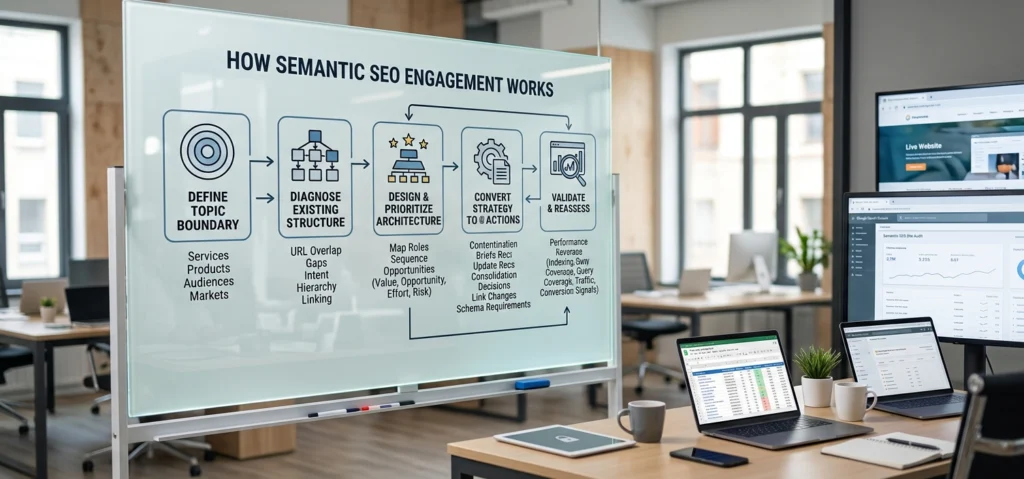
How Semantic SEO Engagement Works

Define the Topic Boundary

I clarify the services, products, audiences, and markets the site genuinely needs to cover.

Diagnose the Existing Structure

I review current URLs, query overlap, topical gaps, page intent, hierarchy, and linking relationships.

Design and Prioritize the Architecture

I map page roles and relationships, then sequence opportunities by business value, search opportunity, dependency, effort, and risk.

Convert Strategy Into Actions

The architecture becomes content briefs, page-update recommendations, consolidation decisions, internal-link changes, and structured-data requirements where relevant.

Validate and Reassess

After implementation, performance should be reviewed through indexing, query coverage, page-level search data, content quality, and conversion signals. Priorities can change as SERPs, competitors, products, and customer behavior change.

Practical Execution

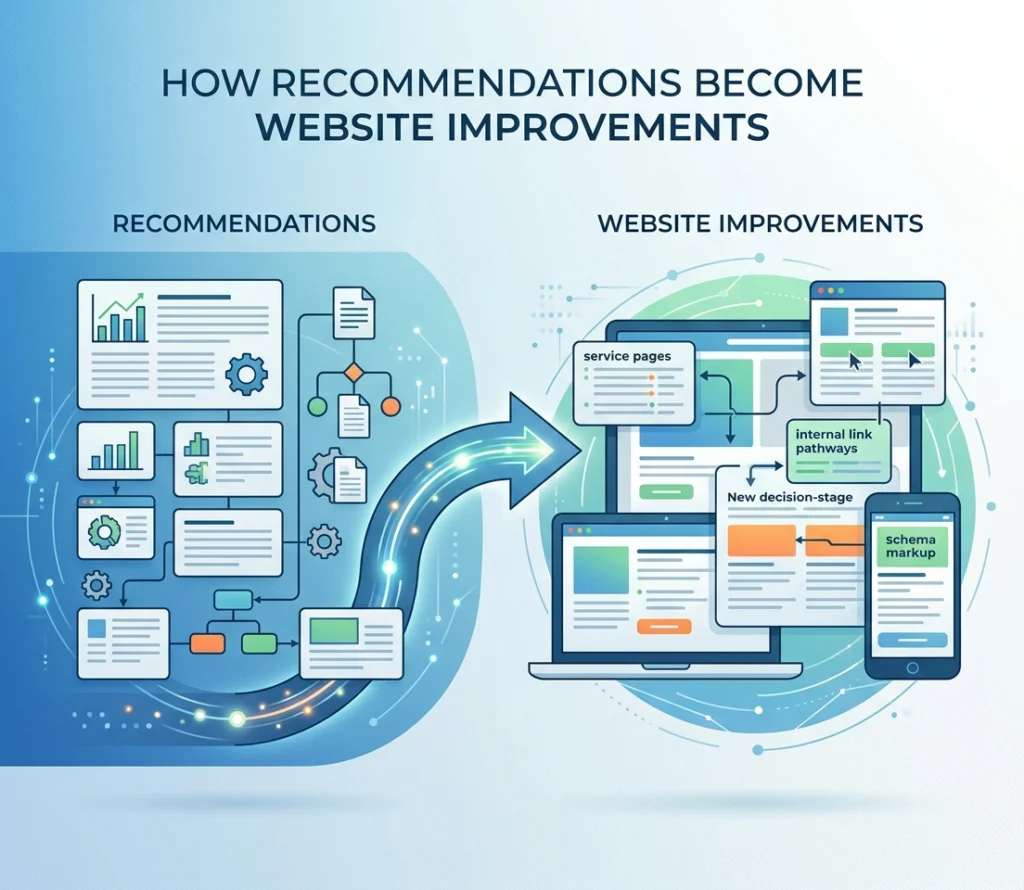
How Recommendations Become Website Improvements

How Recommendations Become Website Improvements

A strategy only matters when it can be implemented. I turn recommendations into actions a business owner, editor, SEO, or development team can use.

That may mean improving an existing service page instead of creating a new one, merging competing articles, adding a missing decision-stage page, restructuring a cluster, strengthening contextual links, or delaying a low-value topic until higher-impact foundations are complete.

Content capacity, development effort, review requirements, and ownership can change the ideal sequence.

RESULTS

Outcomes Semantic SEO Can Support

Semantic SEO is not just about completing audits or writing isolated articles. The real value comes from building a logical, connected site structure that supports sustainable long-term growth.

Clearer Query Ownership

Stronger Topical Authority

Reduced Keyword Cannibalization

Contextual Internal Linking

Better Editorial Efficiency

Clearer Entity Understanding

Qualified Organic Visibility

WHY PARTHO

Why Choose Partho Saha For Semantic SEO Services?

I treat Semantic SEO as an architecture and decision-making challenge, prioritizing topical logic over arbitrary content volume. Research guides every recommendation, ensuring business relevance always comes before maximum topical breadth. One strong, clearly defined page will create more value than five overlapping URLs.

  • Architecture-First Mindset: Focuses on clear page roles, entity relationships, and internal link logic to prevent query cannibalization.

  • Pragmatic Prioritization: Evaluates search demand against implementation effort, ensuring development resources go directly to high-impact improvements.

  • Future-Proof Search Foundations: Aligns content with AI discovery and search engines through clear intent, entity consistency, and EEAT-driven evidence.

  • Execution-Ready Strategy: Delivers clear, actionable briefs and structural directives that editors, SEOs, and developers can implement immediately.

Partho Saha SEO Consultant

"Traffic means nothing if it doesn’t convert. Rankings mean nothing if they don’t bring revenue."

Frequently Asked Questions

What do Semantic SEO Services do?

A Semantic SEO Services analyzes how topics, entities, search intents, pages, and internal links work together, then recommends a clearer architecture, topical roadmap, page ownership model, and implementation priorities.

Is Semantic SEO different from keyword research?

Yes. Keyword research identifies search demand. Semantic SEO uses that demand alongside intent, entities, site structure, existing pages, and business priorities to decide how the website should be organized.

Do I need hundreds of pages to build topical authority?

No. More URLs are not automatically better. Sometimes improving or consolidating existing pages creates more value than publishing new ones.

Can Semantic SEO help with AI search visibility?

It can strengthen foundations useful for AI-assisted discovery, including clear page purpose, entity consistency, useful topic coverage, structured information, and crawlable content. It cannot guarantee that an AI system will cite or surface a specific page.

Is this a one-time project or ongoing service?

It can be either. A business may need a one-time semantic audit and topical map, or ongoing support for briefs, implementation, QA, content expansion, and reassessment.

Testimonials

What Clients Say

But don’t just take my word for it see what my clients have to say about the results and experience of working with me.

David Thompson

“Partho Saha is the real deal. His technical SEO audit uncovered critical issues that other agencies had missed for years. Our organic traffic has never been stronger.”

David Thompson

Head of Digital, Nexus Technologies

Emily Johnson

“What sets Partho apart is his ability to connect SEO strategy directly to business outcomes. Every recommendation was data-backed and actionable.”

Emily Johnson

CEO, Atlas Home Services

Michael Carter

“Partho’s strategic approach to SEO transformed our online visibility. We went from page 3 to dominating local search results in under six months.”

Michael Carter

Marketing Director, Brightway Solutions

Get Started

Review Your Semantic SEO Opportunities

If your site has content but lacks clear topical structure, the next step is to identify where overlap, missing coverage, weak relationships, or poor prioritization are limiting the system.

During an initial strategy discussion, I can review your website and business context, clarify the topics that matter commercially, identify likely structural issues, and recommend the most logical next step.

Save this page and contact Partho Saha when you are ready to fix keyword cannibalization, build true topical authority, and structure your website for maximum visibility in Google and AI search.

Scroll to Top