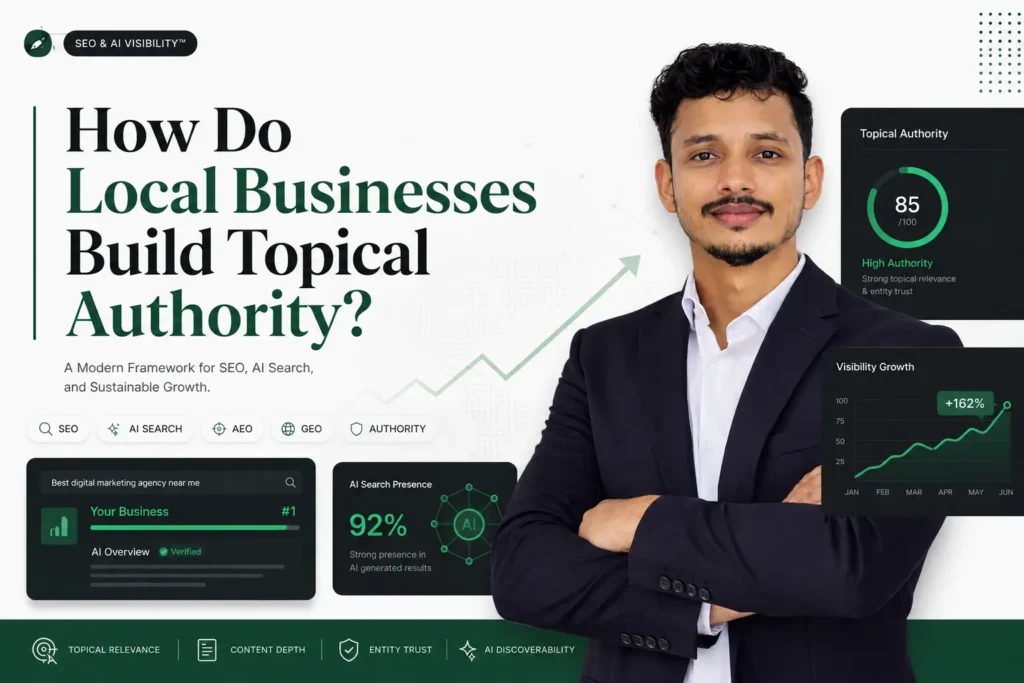
Local businesses build topical authority by publishing useful and organized content around their services, customer questions, locations, and expertise. The goal is to help search engines and potential customers understand what the business does, where it operates, and why it is a trustworthy choice.
For law firms and local service businesses, topical authority can support stronger visibility across Google Search, Google Business Profile, and Maps results. It can also help turn website traffic into qualified enquiries.
What Is Topical Authority in Local SEO?
Topical authority is the depth and relevance a website demonstrates within a specific subject area. A local business builds authority when it covers core services clearly, answers common questions, and connects related pages through internal links.
For example, a family law firm should not rely on one broad legal services page. It may need pages for divorce, child custody, mediation, property division, and consultations. Supporting articles can answer questions about cost, timelines, and documents.
Start With Revenue Generating Services
A strong local SEO content strategy begins with the services that generate calls, consultations, bookings, or sales.
Each priority service should have one complete page explaining the service, the problems it solves, who needs it, pricing factors, service areas, common questions, and the next step.
Avoid creating several pages that target almost the same keyword. When pages overlap too closely, they may compete with each other and make the website harder to understand.
Research Real Customer Questions
Topical authority grows when a website answers questions customers ask before making a decision. Useful topics include cost, time, urgency, repair versus replacement, safety, preparation, and service areas.
A law firm might publish content about consultation costs or required documents. A contractor might publish content about repair costs, seasonal damage, or safety concerns.
Create a Topical Map
A topical map is a structured content plan. It organizes the website around services, supporting questions, relevant locations, and customer intent.
A simple topical map may include service pages, supporting blog posts, location pages, FAQs, conversion pages, and internal linking opportunities.
For example, an HVAC company may have an AC repair page, an article about common AC problems, a cost guide, and a summer checklist. These pages should support each other instead of existing as isolated content.
Build Strong Service Pages Before Publishing More Blogs
Many businesses publish blog posts while their service pages remain thin or outdated. This limits results.
A strong service page should explain the problem, the solution, the process, pricing factors, local considerations, FAQs, and a call to action. Supporting blogs should answer specific questions and guide readers toward the relevant service page.
Add Local Context Naturally
Local content should reflect conditions customers face in a specific market. This may include climate, seasonal risks, local procedures, neighborhood characteristics, or service area logistics.
Do not repeat a city name in every paragraph. Do not create dozens of near duplicate location pages. Each page should provide distinct value.
A tree service company may discuss storm risks in a coastal region. A law firm may explain local procedures that matter to clients in its service area.
Use Internal Links to Connect Related Content
Internal links help customers navigate the website and help search engines understand how pages relate to each other.
A useful structure can move readers from a homepage to a service page, then to a supporting blog post, an FAQ section, and a contact page.
Use descriptive anchor text. A blog about warning signs should point readers toward the relevant service page.
Strengthen Trust and EEAT Signals
Topical authority is not only about publishing more content. Trust matters.
Local businesses should include accurate contact details, a clear About page, named authors, genuine experience, customer reviews, original photos, and case studies.
EEAT refers to experience, expertise, authority, and trust. These signals are especially important for law firms and businesses handling urgent or sensitive needs.
Avoid fake reviews, unsupported claims, generic writing, and promises of instant rankings.
Can Topical Authority Improve Google Maps Visibility?
Topical authority can support local SEO by improving website relevance, service clarity, and trust. However, it is not a shortcut to Google Maps rankings.
Maps visibility also depends on Google Business Profile optimization, proximity, reviews, citations, local prominence, and competition. A strong website should work together with an accurate business profile.
When to Call a Professional
Professional SEO support may be useful when a website has many pages but limited enquiries, competitors consistently rank higher, or the business lacks a clear content strategy.
It may also be time to speak with an SEO consultant when service pages are thin, location pages are repetitive, important pages are not indexed, several pages target the same keyword, or traffic does not convert into leads.
Why Choose Partho Saha?
Partho Saha helps law firms and local service businesses build sustainable Google visibility and predictable inbound leads through strategy driven SEO.
As an SEO Consultant specializing in Local SEO, AEO, GEO, and AI Search Optimization, Partho Saha focuses on structured search systems rather than short term ranking improvements.
The approach includes Google Business Profile optimization, EEAT aligned content frameworks, internal linking strategy, and AI search visibility planning.
The goal is to strengthen authority, improve local and transactional visibility, and support consistent enquiries over time.
Frequently Asked Questions
Should a local business publish service pages or blog posts first?
Start with complete service pages. Publish supporting blog posts after the core pages clearly explain the business offer.
Does every keyword need a separate page?
No. Closely related keywords with the same search intent should usually be grouped into one useful page.
Final Thoughts
Local businesses build topical authority by creating a connected content system around services, customer questions, locations, and expertise. Start with strong service pages, publish helpful articles, add natural local context, use internal links, and strengthen trust signals. A structured strategy can create lasting visibility and better lead quality.