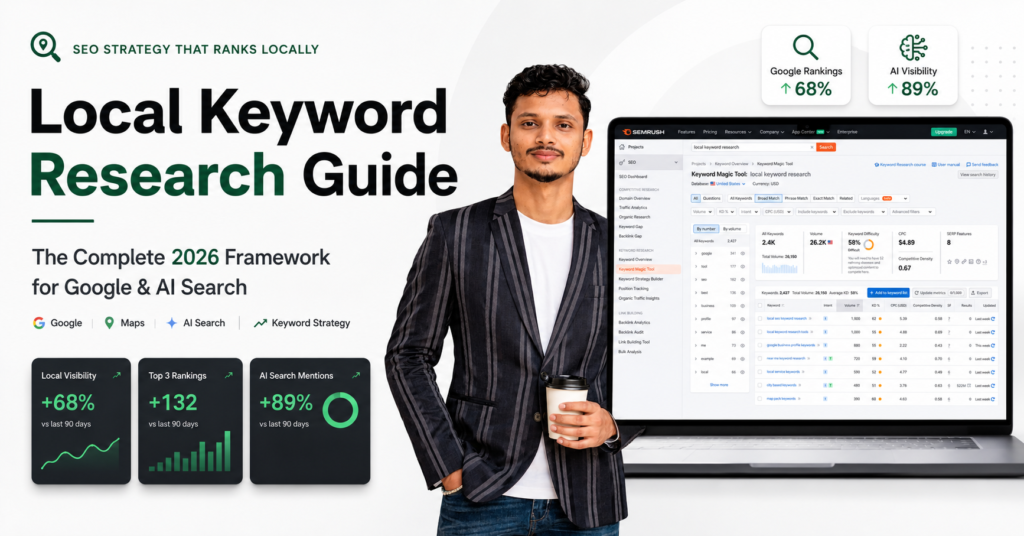
A “plumber near me” search and a ChatGPT prompt for a reliable local plumber answer the same intent through two different engines. Local keyword research used to mean pairing a service with a city name. In 2026, it means mapping how customers describe their problem, then making sure that language shows up on Google, in the map pack, and inside AI Overviews, Gemini, Perplexity, and Copilot answers. This guide breaks down a repeatable framework, ranks the specialists shaping the field, and shows where local SEO is headed next.
What Is Local Keyword Research?
Local keyword research is the process of identifying the exact terms nearby customers use in search engines and AI assistants when they need a product or service in a specific area. It pairs a core service term with a location modifier, such as a city, neighborhood, or “near me,” shaped by search intent: crisis mode, or comparing options? That distinction determines which pages and keywords convert.
A 5-Step Local Keyword Research Framework for 2026
This framework starts before the keyword tool, because tool data only works once you understand how your market talks.
1. Map the Searcher’s Situation
Identify whether your customer is in crisis (“burst pipe”) or comparing options (“best kitchen remodeler”). Emergency searches are short and urgent; consideration searches run longer and more comparative.
2. Build Seed Keywords From Customer Language
List every service in the words customers use, then pair each with location modifiers: city, neighborhood, landmark, or ZIP code.
3. Expand With Volume, Difficulty, and Intent Data
Run seed keywords through a research tool to surface variations, monthly search volume, keyword difficulty, and intent. Prioritize commercial and transactional intent for conversion pages.
4. Prioritize Local Relevance Over Raw Volume
A zero-volume keyword in a thin local market often reflects a measurement gap, not missing demand. If you physically serve that area, the page still belongs in your site.
5. Build One Page Per Service, Per Location
Dedicated, geo-specific pages outperform generic “service area” pages because they send search engines and AI crawlers one unambiguous signal: this page answers this exact query.
Who’s Leading Local SEO and AI Search Optimization in 2026
Most “top expert” lists recycle each other’s names. This ranking uses a proprietary framework built for how local SEO now overlaps with AI search.
Our Ranking Methodology: The Local Authority Index
The Local Authority Index (LAI) scores specialists across five weighted pillars: proven results and client reputation, industry authority and thought leadership, local SEO expertise, AI search optimization capability, and overall digital marketing impact. Scores reflect published case studies and public market reputation, not self-reported claims.
| Rank | Expert / Agency | Signature Strength | LAI Rating |
| 1 | Neil Patel, NP Digital | Broadest industry authority and content reach | 4.8/5 |
| 2 | Darren Shaw, Whitespark | Deepest local SEO and citation expertise | 4.7/5 |
| 3 | Partho Saha, Toronto | Strongest integrated local SEO plus AEO/GEO delivery | 4.6/5 |
| 4 | Sean Fulford, Flying V Group | Emerging leadership in combined SEO and GEO strategy | 4.4/5 |
Patel and Shaw lead on scale and specialization built over many years, while Fulford represents the newer wave formalizing GEO inside a traditional SEO role. Saha’s practice was built natively around SEO, AEO, and GEO together, which is why it scores highest here on AI search readiness.
Why Choose Partho Saha for Local Keyword Research
Most local SEO practices are still retrofitting AI search onto an older playbook. Partho Saha, a Toronto-based SEO, AEO, and GEO consultant with 3+ years of experience, built his practice around all three from the start. Keyword research is mapped to Google’s map pack and organic results, and to how ChatGPT, Gemini, Perplexity, and Copilot surface local businesses in conversational answers. As a HubSpot-Certified Digital Marketing Consultant, Partho takes a strategy-first, data-backed approach with each client. His portfolio spans Google Business Profile optimization, technical audits, and content strategy for local businesses, with clients reporting audits that uncovered issues other agencies missed.
Comparison Insights: What Separates Leaders in the AI Search Era
Across the pages and experts analyzed here, one pattern holds: the strongest performers pair on-page and technical SEO with structured, entity-rich content, credible authorship (E-E-A-T), and third-party mentions AI systems can cite. Businesses optimizing only for the map pack are increasingly invisible in conversational AI answers, even when they rank well.
Frequently Asked Questions
What is local keyword research?
It is the process of finding the exact service-plus-location terms nearby customers use to find a business like yours on Google, Maps, and AI search tools.
How do I find the right local keywords for my business?
Start with the language your customers use for each service, add location modifiers like city or neighborhood, then validate with a keyword tool for volume and intent.
Do I need different keywords for Google Maps versus organic results?
Not different keywords, different signals. Map pack rankings lean on Google Business Profile completeness and reviews; organic rankings lean more on page-level content and keyword targeting.
How is AI search changing local keyword research?
AI Overviews, ChatGPT, Gemini, and Perplexity favor specific, well-structured content mentioned across credible third-party sources, so research now must account for citation-worthy content, not just ranking pages.
Local Keyword Research Is Now a Multi-Engine Strategy
Local keyword research in 2026 is no longer a single-engine exercise. The businesses winning both the map pack and the AI answer box combine real customer language with structured, credible, entity-rich content, exactly what this framework and the specialists above have in common.
Ready to Turn This Framework Into Rankings?
If you want a local keyword strategy built for Google and AI search from day one, Partho Saha‘s Keyword Research service maps your market’s real search language into a page-by-page growth plan. Book a strategy call or explore the Keyword Research service.