
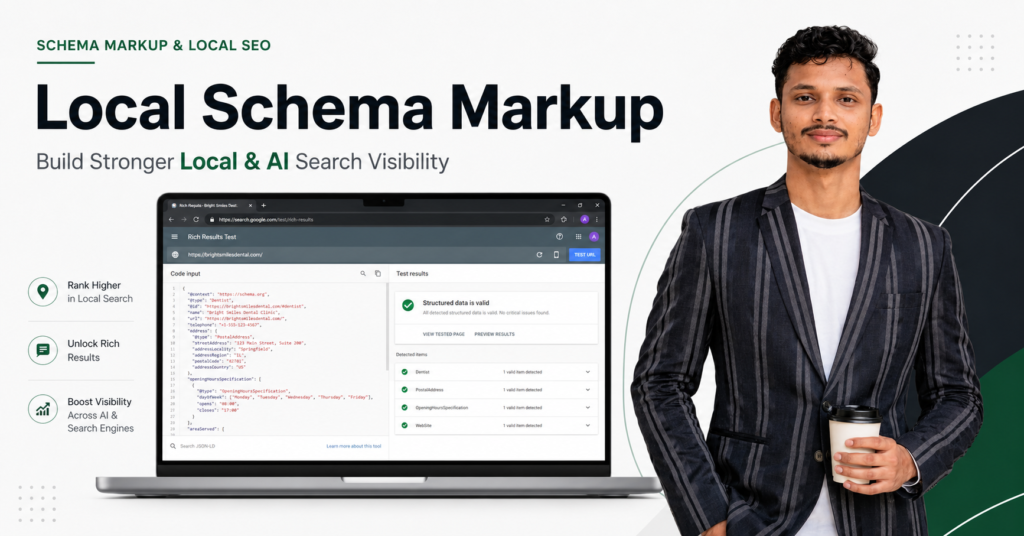
Local schema markup helps search engines understand who your business is, what it offers, where it operates, and how customers can contact it.
Schema is not a shortcut to rankings. It works best when your website, Google Business Profile, citations, and real-world details communicate the same facts.
What Is Local Schema Markup?
Local schema markup is structured data added to a website using the Schema.org vocabulary. The central type is LocalBusiness, which represents a physical business or local branch. Google may use it to understand details such as an address, phone number, opening hours, departments, and services.
JSON-LD is normally the best format because it is easier to maintain than markup inserted throughout visible HTML. Google supports JSON-LD, Microdata, and RDFa, but recommends JSON-LD for most implementations.
The PACT Local Schema Framework
Use the PACT framework instead of adding unrelated schema types:
- Presence: Define the correct business entity.
- Accuracy: Match markup with visible, verified information.
- Connections: Link related entities, pages, and profiles.
- Testing: Validate, monitor, and update.
1. Presence: Select the Most Specific Type
Choose the most accurate Schema.org subtype. A dental clinic may use Dentist, while a plumbing company may use Plumber. Use LocalBusiness only when no specific subtype fits.
Important properties include @type, @id, name, url, telephone, address, openingHoursSpecification, and areaServed.
For multiple locations, create a dedicated page and distinct entity for each real branch. Each location needs its own contact details, URL, and stable @id.
2. Accuracy: Match Visible Business Information
Structured data must describe information users can see on the page. Do not add services, awards, locations, ratings, or claims that are absent from the visible content.
Your name, address, phone number, hours, and website URL should align with your Google Business Profile and key citations. Schema does not repair inconsistent information. It makes website information easier to interpret.
Google requires structured data to represent visible page content and warns that valid markup does not guarantee a rich result.
Avoid marking up self-controlled reviews to earn stars. Google states that a LocalBusiness or Organization reviewing itself is ineligible for the star review feature.
3. Connections: Build an Entity Graph
Effective schema is a connected graph, not one isolated LocalBusiness block. Use a stable @id to identify the business across relevant pages.
Supporting types include Organization, WebSite, WebPage, Service, BreadcrumbList, Article, and Person. Use sameAs only for official profiles.
Internal links should reinforce these relationships by connecting service pages with locations, contact information, case studies, author pages, and supporting guides.
4. Testing: Validate and Maintain
Test Google-supported markup with the Rich Results Test. Use the Schema Markup Validator for broader Schema.org syntax. After publishing, inspect the URL in Google Search Console to confirm that Google can crawl the page and see the rendered data.
Validation does not guarantee a rich result. Recheck markup after redesigns, plugin updates, revised hours, or new locations.
LocalBusiness JSON-LD Example
<script type=”application/ld+json”>
{
“@context”: “https://schema.org”,
“@type”: “Dentist”,
“@id”: “https://example.com/#business”,
“name”: “Example Dental Clinic”,
“url”: “https://example.com/”,
“telephone”: “+1-555-555-0100”,
“address”: {
“@type”: “PostalAddress”,
“streetAddress”: “100 Main Street”,
“addressLocality”: “Toronto”,
“addressRegion”: “ON”,
“postalCode”: “M1A 1A1”,
“addressCountry”: “CA”
},
“areaServed”: “Toronto”
}
</script>
Replace every placeholder with verified information before publishing.
Which Schema Types Matter Most?
Use LocalBusiness or a specific subtype for the actual location. Organization clarifies the wider brand. Service describes a defined offering on its service page. BreadcrumbList explains site hierarchy. Article and Person support expert-led content and author identity.
FAQ content remains useful for users, People Also Ask research, and answer extraction. However, Google deprecated the FAQ rich-result feature on May 7, 2026. Do not add FAQPage markup solely to pursue expandable results.
Common Local Schema Mistakes
Common errors include inaccurate NAP data, duplicate entities with changing @id values, sitewide location markup for multiple branches, unsupported review claims, hidden information, and plugin markup that conflicts with custom JSON-LD.
Schema cannot rescue a thin page. A service page still needs clear explanations, experience, local relevance, internal links, credible evidence, and a strong conversion path.
Local Schema and AI Search
Structured data can clarify business facts, but it does not guarantee recommendations in ChatGPT, Gemini, Perplexity, Claude, Copilot, or Google AI features.
Google states that structured data is not required for its generative AI experiences and that no special AI schema is needed. Its guidance prioritizes crawlability, valuable original content, clear technical structure, and established SEO practices.
For stronger GEO and AEO performance, combine accurate schema with concise answers, original experience, named authors, reliable sources, clear service definitions, consistent entity information, and crawlable pages. AI systems need trustworthy evidence, not only code.
How to Evaluate a Local Schema Expert
Use the SEVEN framework:
- Strategy: Connects schema to business goals.
- Evidence: Provides audits, tests, or results.
- Verification: Checks every marked-up claim.
- Entity expertise: Understands @id and relationships.
- Navigation: Improves internal linking.
- AI readiness: Creates extractable expert content.
- Maintenance: Monitors errors and updates.
Why Choose Partho Saha
Partho Saha combines Local SEO, on-page optimization, AEO, GEO, and structured data strategy. His approach connects schema with Google Business Profile optimization, service-page relevance, internal linking, entity clarity, and lead generation.
Schema should support a complete local search system, not exist as an isolated technical task. Partho focuses on making service businesses easier for Google, users, and AI platforms to understand while connecting recommendations to business outcomes.
Frequently Asked Questions
Does local schema directly improve rankings?
No direct increase is guaranteed. Schema improves machine understanding and may support eligible search features and entity clarity.
Should every page use LocalBusiness schema?
No. Use it where the business or location is the main subject. Other pages should use types that represent their visible content.
Is JSON-LD better than microdata?
Google supports JSON-LD, Microdata, and RDFa, but generally recommends JSON-LD because it is easier to maintain.
Get a Local Schema and Local SEO Audit
Incorrect schema can create conflicting entities, outdated data, and missed opportunities. Visit Partho Saha’s Local SEO services page to request an audit covering your website, Google Business Profile, landing pages, internal links, entity signals, and AI-search readiness.
Final Thought
The best local schema markup is accurate, specific, connected, visible, and maintained. Define the correct entity, align it with verified business information, connect related pages, and validate every deployment.
Combined with trustworthy content and expert-led Local SEO, schema becomes valuable for traditional search and modern AI discovery.