Your website can look professional, explain your services clearly and still generate very little business from Google. The problem is often not the website itself. It is whether search engines can find it, understand it and consider it relevant when potential customers search.
That is where SEO comes in.
SEO, or search engine optimization, is the process of improving your website and online presence so search engines can understand your content and the right people can discover it through organic search results.
For a business owner, the objective is not simply “more rankings.” Effective SEO should help your business become visible for searches that can contribute to enquiries, bookings, calls or sales.
How Does SEO Work?
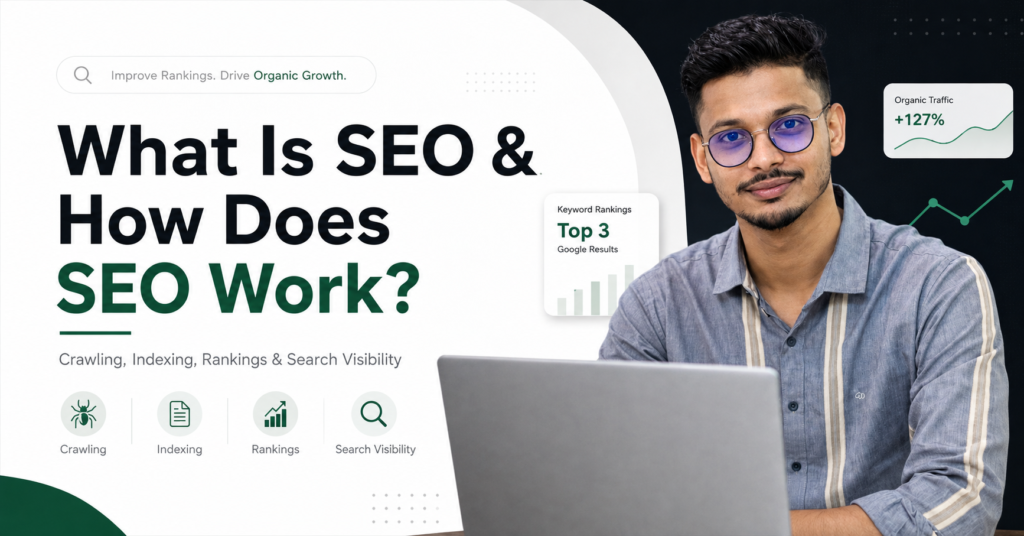
Google describes Search as operating through three broad stages: crawling, indexing and serving search results.
1. Crawling: Google Discovers Your Pages
Search engines use automated crawlers to discover webpages.
They may find a page through:
- Internal links
- Links from other websites
- XML sitemaps
- Pages they have previously discovered
If an important service page is blocked, broken or difficult to reach through your website architecture, search engines may have difficulty processing it properly.
2. Indexing: Google Tries to Understand the Page
After crawling a page, Google analyses its content and other information to understand what the page represents. It may also determine which URL should be treated as the canonical version when similar pages exist.
This is where clear titles, headings, content, internal links, images and overall page context become important.
3. Serving and Ranking Results
When somebody searches, Google attempts to return useful results relevant to that query.
SEO therefore does not mean convincing Google to rank a page through one trick. It means improving the signals that help search engines discover, understand and evaluate your website while creating something genuinely useful for the searcher.
What Are the Main Types of SEO?
Several areas work together.
| SEO Area | What It Focuses On |
| Technical SEO | Crawlability, indexing, site architecture, mobile usability and technical performance |
| On-Page SEO | Search intent, content, headings, titles, internal links, images and page relevance |
| Off-Page SEO | Backlinks, mentions and other external authority signals |
| Local SEO | Google Business Profile, location relevance, local pages, citations and reviews |
| AI Search/AEO/GEO | Making accurate, useful information easy to understand and retrieve in modern answer and generative-search experiences |
For a Toronto service business, for example, traditional website SEO and local SEO may need to work together. A useful service page can target relevant searches while the business’s local presence helps people discover it in location-based search experiences.
AI search does not make these fundamentals obsolete. Google says its generative Search features continue to rely on core Search ranking and quality systems.
What Should a Business Owner Prioritize?
I find it more useful to evaluate SEO through four practical layers.
Discoverability
First ask: Can search engines properly access and index the important pages?
Technical problems should be addressed before investing heavily in content that search engines cannot process effectively.
Relevance
Next ask: Does each page answer the right search intent?
A page targeting “emergency plumber Toronto,” for example, should not read like a general history of plumbing. Its content should help someone dealing with an immediate plumbing problem understand the service, location, next steps and reasons to choose the provider.
This is where keyword research, content strategy and on-page SEO work together.
Authority and Trust
A technically perfect page is not automatically the best result.
Search engines also need signals that help establish the website and its information as credible. Depending on the business, these can include useful expert content, legitimate backlinks, consistent business information and a strong reputation.
Conversion
Traffic alone is not the finish line.
Once someone reaches the page, can they quickly understand:
- What you offer
- Whether it solves their problem
- Why they should trust you
- What they should do next
SEO that produces traffic without meaningful business actions may need a conversion problem fixed rather than simply more keywords.
SEO vs Paid Advertising: What Is the Difference?
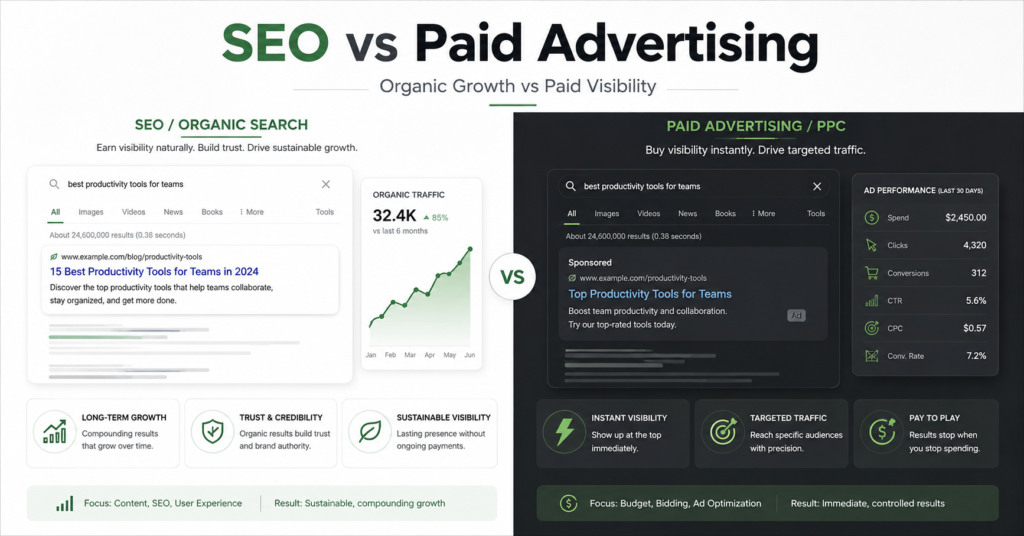
SEO focuses on earning visibility in organic search results. Paid search uses advertising to purchase visibility.
Google explicitly states that businesses cannot pay Google to receive higher organic rankings.
SEO is not literally free. You may invest in content, expertise, development and tools but you are not paying Google for each organic position.
Many businesses use SEO and paid advertising together: advertising can provide immediate visibility while SEO develops an organic search asset over time.
How Long Does SEO Take?
There is no universal SEO timeline.
Google notes that some website changes may be reflected within hours while others can take months, and recommends allowing at least several weeks before evaluating many changes.
The practical timeline depends on factors such as competition, current website condition, existing authority, technical problems, content quality and the searches being targeted.
That is why promises of guaranteed rankings within a fixed period should be treated cautiously.
How Do You Know Whether SEO Is Working?
Business owners should look beyond one keyword ranking.
Useful indicators include:
- Organic impressions
- Organic clicks
- Visibility for relevant queries
- Non-branded organic traffic
- Local search visibility
- Qualified enquiries
- Calls or bookings
- Leads and revenue influenced by organic search
Google Search Console is particularly useful for understanding how pages and queries are performing in Google Search.
The final question should be: Is organic visibility bringing more of the right potential customers into the business?
Can You Do SEO Yourself?
Yes. A business owner can handle many SEO basics, especially on a small website.
You can learn how to improve page titles, create genuinely useful content, strengthen internal links, maintain your Google Business Profile and monitor Search Console.
Professional help becomes more useful when you have indexing problems, declining traffic, strong competitors, a large website, unclear keyword targeting, technical issues or limited time to implement the work properly.
If you are unsure which problem deserves attention first, a website audit or SEO strategy review can prevent you from spending months improving the wrong thing.
Is SEO Still Worth Doing in the Age of AI Search?
Yes but the definition of search visibility is becoming broader.
People can now discover businesses through traditional search results, Google Maps, AI Overviews, AI Mode and conversational search systems.
Google’s current guidance is particularly important here: businesses do not need to abandon SEO or create special “AI-only” content for Google’s generative Search features. Strong technical foundations, valuable original content and clear business information remain fundamental.
What Should You Do Next?
SEO works best when you stop treating it as a collection of isolated tricks and start treating it as a system.
Make sure search engines can discover your website. Create pages that genuinely satisfy the right search intent. Build authority around the business. Then make it easy for qualified visitors to become customers.
If you are unsure where your website is losing search visibility, you can review Partho Saha’s SEO consulting process or request an assessment to identify the highest-priority opportunities before committing to a larger SEO campaign.
Frequently Asked Questions
What does SEO stand for?
SEO stands for Search Engine Optimization. It describes the work used to improve a website’s organic visibility in search engines.
What is SEO in simple terms?
SEO helps search engines understand your website and helps potential customers find relevant pages when they search for information, products or services.
Is SEO free?
Organic rankings are not purchased from Google, but SEO itself may require investment in strategy, content, technical work, tools or professional support.
How long does SEO take to work?
There is no fixed timeline. Some changes can appear relatively quickly while competitive improvements may take substantially longer. Evaluate progress over meaningful periods rather than expecting instant ranking changes.
Does SEO work for local businesses?
Yes. Local SEO can help eligible businesses improve visibility for location-based searches and Google Maps alongside their standard website SEO.
Is SEO still important with ChatGPT and AI search?
Yes. Search behaviour is expanding, but solid technical SEO, useful content, authority and clear entity information still provide an important foundation for traditional and AI-assisted discovery.
Should I hire an SEO consultant?
Consider professional help when you lack time or expertise, have significant technical or indexing issues, compete in difficult search markets, or need a clear strategy connecting search visibility with leads and revenue.