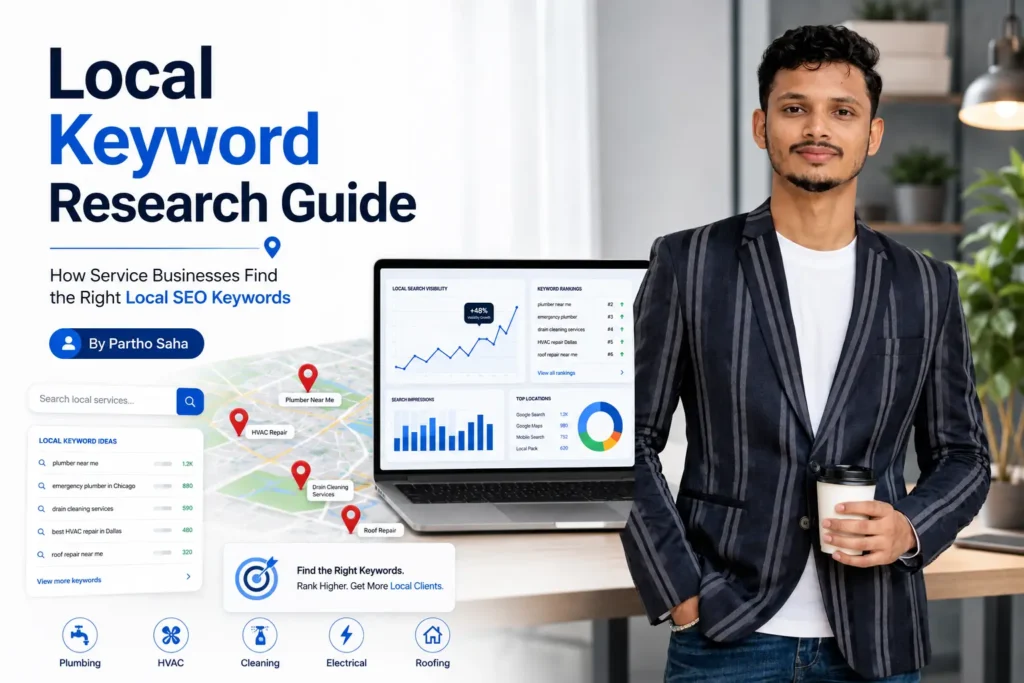
Local keyword research is the foundation of every successful local SEO campaign. For service businesses, the right keywords do more than bring traffic. They help attract nearby customers who are ready to call, book, compare, or request a quote.
A plumber, dentist, roofer, wedding officiant, cleaner, or repair company does not need random website visitors. They need people searching with local intent, such as “emergency plumber near me,” “best dentist in Austin,” or “roof repair in Tampa.”
This local keyword research guide by Partho Saha will show you how to find, organize, and use keywords that support Google Search, Google Maps, AI Overviews, voice search, and lead generation.
What Is Local Keyword Research?
Local keyword research is the process of finding search terms people use when looking for products or services in a specific city, neighborhood, or service area.
For example:
| General Keyword | Local Keyword |
| plumber | emergency plumber in Dallas |
| dentist | family dentist near me |
| wedding officiant | wedding officiant Rochester NY |
| tree service | tree removal Halifax |
The goal is simple: understand how local customers search and create pages that match their exact needs.
Why Local Keyword Research Matters for Service Businesses
Service businesses often depend on local visibility. When someone searches for a nearby solution, they usually have high buying intent.
Strong local keyword research helps you:
- Rank for service + city searches
- Improve Google Maps relevance
- Build better service pages
- Create location-based content
- Attract qualified leads
- Support voice search and AI-generated answers
- Reduce wasted traffic from broad keywords
Google’s people-first content guidance also emphasizes creating helpful content for real users, not content made only to manipulate rankings. (Google for Developers)
How to Do Local Keyword Research Step by Step
1. Start With Your Core Services
List every service your business offers.
Example for a roofing company:
- roof repair
- roof replacement
- emergency roof repair
- flat roofing
- metal roofing
- roof inspection
Each service can become a keyword cluster.
2. Add Location Modifiers
Now add cities, towns, neighborhoods, and service areas.
Examples:
- roof repair in Miami
- emergency roofer Tampa
- flat roofing Orlando
- roof inspection near me
For multi-location businesses, create separate keyword groups for each service area.
3. Identify Search Intent
Not every keyword has the same purpose.
| Intent Type | Example | Best Content Type |
| Commercial | best HVAC company in Phoenix | Service page |
| Transactional | emergency AC repair near me | Landing page |
| Informational | why is my AC not cooling | Blog post |
| Pricing | AC repair cost in Dallas | Cost guide |
| Comparison | plumber vs handyman | Blog or guide |
Matching intent is one of the biggest ranking opportunities.
4. Use Google Search Clues
Search your main keyword and study:
- Google Autocomplete
- People Also Ask
- Related searches
- Local Pack results
- Competitor title tags
- Review language
- Service categories
- Map listings
These clues show how real customers describe their problems.
5. Analyze Competitor Keywords
Look at competitors ranking in your city. Review their:
- Service pages
- Location pages
- Blog topics
- FAQ sections
- Google Business Profile categories
- Review keywords
- Internal links
Competitor gaps often reveal easy content opportunities. For example, if competitors target “plumber in Chicago” but ignore “emergency pipe repair Chicago,” that may be a high-intent gap.
Best Local Keyword Formula
Use this formula:
Service + Modifier + Location
Examples:
- emergency dentist in Houston
- affordable house cleaning in Brooklyn
- same-day appliance repair in Arlington
- best wedding officiant in Rochester
- tree removal service near me
Modifiers can include:
- best
- affordable
- emergency
- same-day
- licensed
- near me
- cost
- open now
- trusted
- professional
How to Map Local Keywords to Pages
Keyword mapping prevents keyword cannibalization and helps every page serve a clear purpose.
| Keyword Type | Example | Best Page |
| Main service keyword | local SEO services | Service page |
| Service + city | appliance repair Arlington TN | City page |
| Problem keyword | washer not spinning | Blog post |
| Cost keyword | washer repair cost | Pricing guide |
| Near me keyword | dentist near me | GBP + service page |
Do not create thin city pages by only changing the city name. Each location page should include unique proof, local examples, service details, testimonials, and area-specific FAQs.
AI Search Optimization Strategy
To appear in Google AI Overviews, ChatGPT-style search, Perplexity, Gemini, Bing Copilot, and voice search, your page should answer questions clearly.
Use direct answer blocks like this:
Local keyword research helps service businesses identify the exact search terms nearby customers use when looking for local services, pricing, availability, and trusted providers.
AI systems often extract concise, well-structured answers. Use:
- Question-based H2s
- Short definitions
- Step-by-step lists
- Tables
- Examples
- FAQs
- Entity-rich paragraphs
- Clear local business context
Also add structured data where relevant. Google’s LocalBusiness structured data can help clarify business information such as hours, departments, and business details.
EEAT Tips for Local Keyword Research Content
To build trust, include:
- Real service-business examples
- Screenshots from Search Console or keyword tools
- Author bio with SEO experience
- Updated date
- Clear process
- Local case study examples
- Before-and-after keyword mapping
- Transparent recommendations
The best local keywords are not always the highest-volume keywords. In local SEO, a low-volume keyword like “emergency boiler repair near me” may generate better leads than a broad keyword like “boiler.”
Common Local Keyword Research Mistakes
Avoid these mistakes:
- Targeting only broad keywords
- Ignoring low-volume, high-intent keywords
- Creating duplicate location pages
- Stuffing city names unnaturally
- Forgetting Google Business Profile optimization
- Not separating blog keywords from service keywords
- Ignoring reviews as keyword research data
- Not tracking rankings by location
People Also Ask: Local Keyword Research FAQ
What is local keyword research?
Local keyword research is the process of finding search terms people use to find services, products, or businesses in a specific area.
How do I find local SEO keywords?
Start with your services, add city or neighborhood modifiers, check Google Search suggestions, study competitors, review customer questions, and group keywords by intent.
Are “near me” keywords important?
Yes. “Near me” keywords show strong local intent. However, you should use them naturally and support them with accurate Google Business Profile details, local content, and location signals.
Should every city have its own page?
Only if each city page has unique, useful content. Avoid creating duplicate pages where only the location name changes.
What are the best tools for local keyword research?
Useful tools include Google Search, Google Keyword Planner, Search Console, Google Business Profile insights, Semrush, Ahrefs, BrightLocal, and competitor SERP analysis.
AI Overview-Ready Summary
Local keyword research helps service businesses find search terms that nearby customers use when looking for local services. The best process is to list core services, add location modifiers, analyze search intent, study competitors, map keywords to the right pages, and optimize content for Google Search, Google Maps, voice search, and AI search engines.
Final Thought
Local keyword research is not just about traffic. It is about finding the search terms that bring real customers, calls, bookings, and sales.
For service businesses, the winning strategy is simple: target the right service keywords, connect them with the right locations, match search intent, build trustworthy content, and optimize for both humans and AI search systems.
Want a stronger local SEO strategy? Work with Partho Saha to build a keyword plan that improves visibility, authority, and qualified leads for your service business.