
Local landing pages can turn location-based searches into qualified leads when they do more than repeat a service page with a city name added. The strongest pages combine genuine local relevance, useful information, technical SEO, AI-search visibility, trust signals, and conversion-focused design.
For businesses serving multiple cities or service areas, the goal is not to create as many pages as possible. The goal is to create pages that give customers in each location a clear reason to trust, contact, and choose your business.
This guide explains how to build local landing pages that are useful for people, understandable to search engines, and designed to convert.
What Is a Local Landing Page?
A local landing page is a dedicated webpage built around a specific service and geographic area.
For example:
- Emergency Plumber in Chicago
- SEO Consultant in Los Angeles
- Roofing Services in Dallas
- Dental Implants in Manchester
A general service page explains what a company offers. A local landing page explains how that service applies to customers in a particular location.
That difference matters.
Someone searching for “emergency plumber in Chicago” is not simply researching plumbing. They are looking for a provider who can serve Chicago, understand their problem, and help them take the next step.
Local Landing Pages vs Service Pages
A service page usually targets a broader commercial topic:
Plumbing Services
A local landing page adds genuine geographic intent:
Emergency Plumbing Services in Chicago
However, changing the city name is not enough.
A strong local page should contain information that makes sense specifically for that area, such as service coverage, neighborhoods, local projects, response expectations, customer experiences, photographs, pricing considerations, or relevant local conditions.
Why Local Landing Pages Can Generate More Leads
Local pages reduce the gap between what someone searches for and what the business presents.
When visitors immediately see their city, required service, relevant proof, and a clear call to action, the page feels more relevant.
Local pages can also support organic search visibility, while Google Business Profile visibility is determined by broader local-search factors. Google says local results are mainly influenced by relevance, distance, and prominence/popularity rather than a single website-page tactic.
That means a landing page should support the complete local search strategy rather than being treated as a shortcut to Google Maps rankings.
Start With Local Search Intent
Before creating a page, determine whether there is genuine demand for the service-location combination.
Keyword research tools such as Google Search Console, Semrush, or Ahrefs can help identify queries such as:
- Chicago emergency plumber
- SEO consultant Los Angeles
- personal injury lawyer Tampa
- bathroom refinishing Toronto
But keyword volume should not be the only deciding factor.
Ask:
What problem is the visitor trying to solve?
Is the search transactional?
Can the business genuinely serve this area?
Does this location deserve its own useful page?
If the answer is yes, the page has a legitimate purpose.
What Makes a Local Landing Page Genuinely Local?
This is where many location-page strategies fail.
A weak page says:
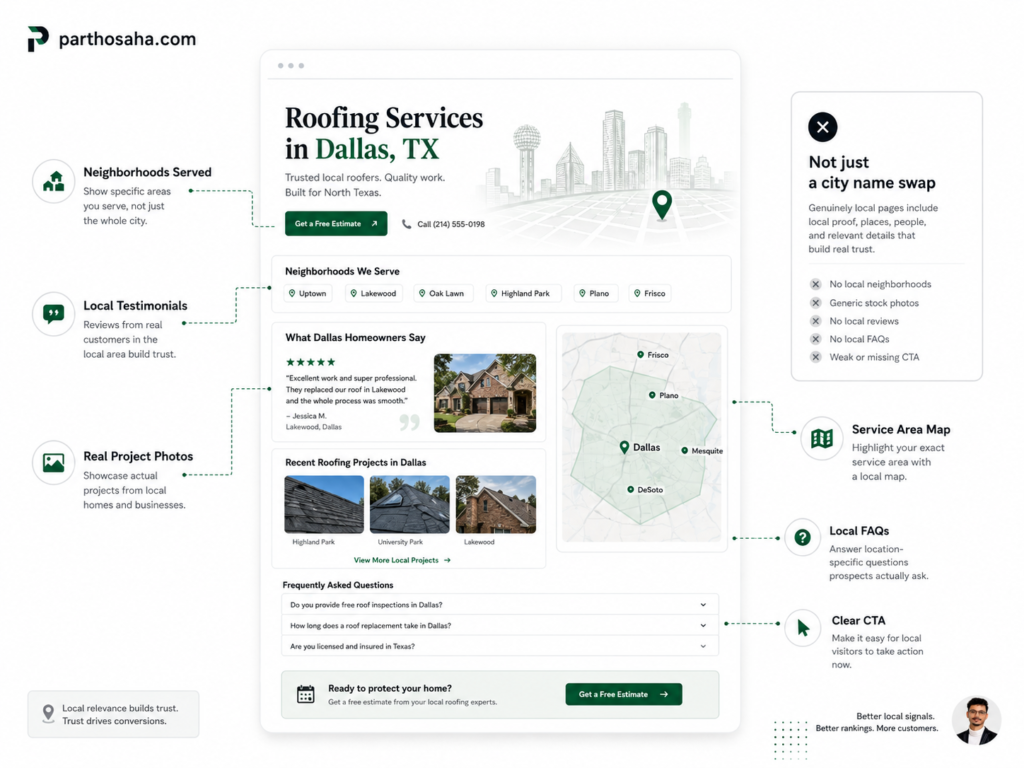
We provide professional roofing services in Dallas. Contact us today.
A stronger page could include:
- Specific Dallas neighborhoods served
- Real projects completed in the area
- Original project photographs
- Customer testimonials from local clients
- Typical response or appointment availability
- Services specifically available in Dallas
- Local weather or property considerations where relevant
- Genuine information about the team serving the area
- Clear contact and booking options
Firsthand information is particularly valuable for modern search. Google’s current guidance for generative AI search emphasizes unique, useful, expert-led content rather than commodity information that simply repeats what already exists elsewhere.
Use This High-Converting Local Landing Page Structure
A practical page structure can look like this:
1. City + Service H1
Example:
Emergency Plumbing Services in Chicago
Keep the headline clear rather than stuffing it with keyword variations.
2. Strong Value Proposition
Within the opening section, explain who you help, where you operate, and why customers should choose you.
3. Primary Call to Action
Place the main action near the top.
Examples:
Request a Quote
Book a Consultation
Call for Emergency Service
4. Local Service Information
Explain the services available in that city and the problems they solve.
5. Areas Served
Mention genuine neighborhoods, districts, or surrounding areas where appropriate.
6. Local Proof
Add real projects, testimonials, photographs, certifications, results, experience, or other verifiable trust signals.
7. Process
Explain what happens after someone contacts the business.
Reducing uncertainty can improve conversion.
8. FAQs
Answer questions customers commonly ask about availability, pricing, service areas, turnaround time, guarantees, or the service itself.
9. Final CTA
Give visitors another clear opportunity to call, book, request a quote, or submit an enquiry.
Optimize Local Pages for AI Search
AI SEO does not require stuffing pages with “LSI keywords” or rewriting every paragraph for machines.
Google says its existing SEO fundamentals continue to apply to AI Overviews and AI Mode, and there are no special technical requirements beyond being eligible for Google Search.
Focus instead on making information clear, useful, crawlable, and distinctive.
Include factual answers about:
- Who provides the service
- What the service includes
- Where it is available
- Who it is suitable for
- What makes the provider different
- What the process involves
- What customers commonly need to know
Google also says AI-search systems can understand synonyms and general meaning, so creating awkward keyword variations purely for AI systems is unnecessary.
Strengthen E-E-A-T Through Evidence
E-E-A-T should not be treated as a checklist or special ranking badge.
Instead, demonstrate real experience and trust.
Show the person or company behind the service. Include author information where relevant, genuine reviews, real project evidence, business credentials, transparent contact information, accurate claims, and original expertise.
For example, when I audit location pages, one question I ask is:
If I removed the city name, would this page still look almost identical to every other location page?
If the answer is yes, the page probably needs more genuine local value.
Avoid Doorway Pages
Do not create hundreds of nearly identical city pages solely to capture location keywords.
Google’s spam policies specifically warn against pages targeting multiple cities or regions that funnel visitors toward essentially the same destination, as well as substantially similar pages created mainly to rank for related searches.
Each local page should therefore have an independent reason to exist.
If you cannot provide useful, location-specific information, one strong service-area page may be better than dozens of thin city pages.
Use Structured Data Correctly
Structured data can help search engines understand information about a business, but it should accurately represent what visitors can see on the page.
Where appropriate, LocalBusiness structured data can communicate business details such as location, opening hours, and other information. Google recommends validating implementation with its Rich Results Test.
Do not invent addresses or create misleading business-location markup for cities where no physical location exists.
Structured data also does not guarantee enhanced search results.
Improve Conversion Rate, Not Just Rankings
Traffic is only useful when the page helps visitors act.
Keep forms simple. Make phone numbers clickable on mobile. Use one clear primary CTA. Avoid distracting navigation where it harms the conversion journey.
Trust should appear close to decision points.
A useful above-the-fold sequence is:
Service + Location → Value Proposition → Trust Signal → CTA
Then reinforce confidence with reviews, examples, guarantees, credentials, service explanations, and FAQs.
Speed matters too. Compress images, remove unnecessary scripts, and make sure important content and CTAs work properly across mobile devices.
Build Useful Internal Links
Local pages should not become isolated URLs.
Link naturally to relevant service pages, nearby location pages, supporting guides, case studies, and important conversion pages.
Google uses links both to discover pages and understand relationships and relevance across a website.
Use descriptive anchor text instead of repeatedly forcing exact-match city keywords.
Measure Whether Local Pages Actually Work
Do not judge success only by rankings.
Track:
- Organic impressions
- Organic clicks
- Qualified enquiries
- Form submissions
- Phone clicks
- Calls
- Bookings
- Conversion rate
- Leads by location
- Revenue where measurable
For AI-search visibility, Google introduced dedicated Generative AI performance reporting in Search Console in June 2026, initially rolling it out to a subset of websites. The reports can show impressions, pages, countries, devices, and performance over time for generative AI experiences.
Final Thoughts
High-converting local landing pages are not mass-produced city pages.
They are useful local resources built around real customer intent.
Combine original local information, clear service positioning, authentic proof, crawlable content, accurate business details, internal links, structured data where appropriate, fast mobile UX, and strong calls to action.
That approach gives a local page a better chance to support traditional search visibility, AI-powered discovery, and most importantly real business enquiries.
If your existing location pages are generating impressions but few leads, or dozens of pages look almost identical, a focused audit can uncover problems with search intent, duplication, local relevance, AI visibility, trust, and conversion flow.
Partho Saha can review your local landing-page strategy and identify where SEO visibility and conversion opportunities are being lost.