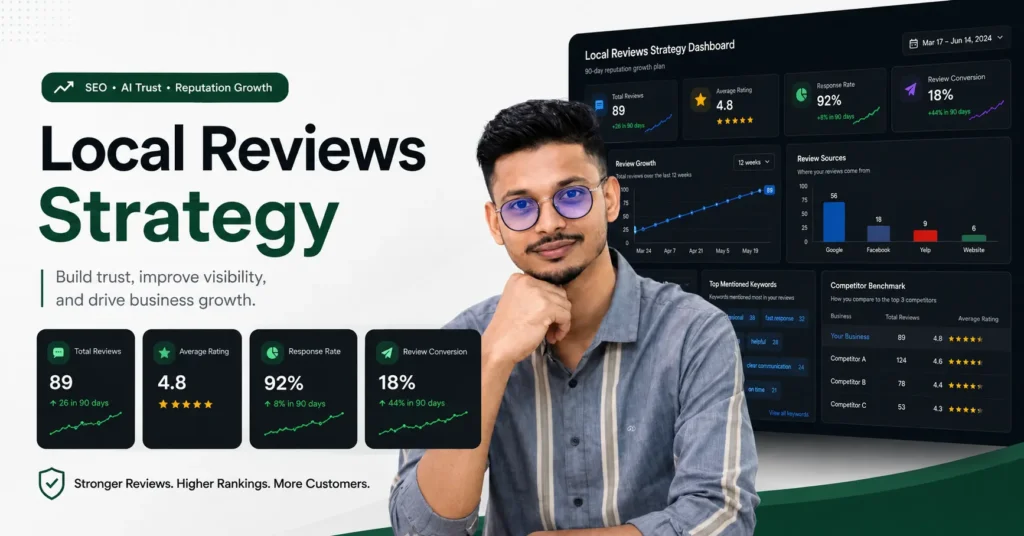
A local reviews strategy is a structured system for earning genuine customer reviews, responding professionally, monitoring reputation signals, and using customer feedback to improve visibility and conversions. It is not simply asking every customer for five stars. A strong strategy connects Google Business Profile reviews, review recency, response quality, platform coverage, customer experience, local SEO, and AI search visibility.
Google states that review quantity and positive ratings can support local ranking, while helpful replies can make a business stand out. Google also allows businesses to share a direct review link or QR code with customers. These recommendations make reviews both a reputation asset and an operational part of local search marketing.
What the Top Local Review Strategy Pages Do Well
The strongest ranking resources cover four recurring themes. Local Visibility System presents a repeatable process involving review-site selection, customer requests, follow-ups, responses, testing, and continuous improvement. SOCi focuses on listings, review volume by location, response rates, and response speed for multi-location brands. Make Me Local connects reviews with trust, local SEO, star ratings, user-generated content, and reputation management. Widewail provides tactical review-generation ideas, author attribution, product links, related articles, and implementation details.
Their main weakness is fragmentation. Some pages focus heavily on collecting reviews, while others concentrate on directories or enterprise software. Few connect review generation with entity optimization, law-firm trust requirements, AI-generated recommendations, conversion tracking, and service-page authority in one methodology.
The TRUST Local Reviews Strategy Framework
T: Target the Right Review Ecosystem
Start with Google Business Profile, but do not treat Google as the only trust source. Identify the platforms customers use to evaluate businesses in your industry, such as Yelp, Facebook, legal directories, trade platforms, and relevant local directories.
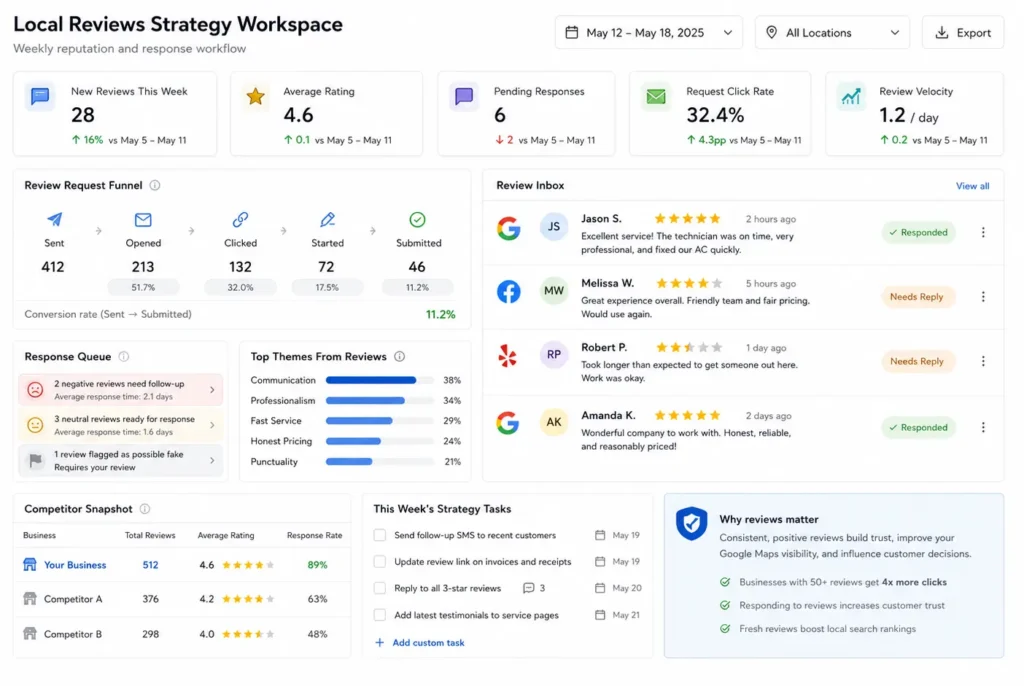
Benchmark competitors by review count, average rating, review recency, response rate, recurring service terms, location mentions, and negative-review themes. The goal is to understand the trust standard customers see before contacting you.
R: Request Reviews at the Right Moment
Create a consistent review request process connected to a real customer milestone. For a law firm, this may follow a completed matter or positive client feedback. For a plumber, cleaner, roofer, or restoration company, the request may follow job completion and customer confirmation.
Use a direct Google review link, email, SMS, invoice message, or QR code. Ask every eligible customer fairly. Do not pressure customers, manufacture reviews, or selectively request feedback only from people expected to leave positive ratings.
U: Understand and Use Customer Feedback
Reviews are more than star ratings. They reveal why customers choose a business, which services they value, what objections they had, and where the customer experience is breaking.
Group review language into themes such as communication, professionalism, speed, pricing clarity, results, location convenience, and staff behaviour. Use these insights to improve service pages, FAQs, sales conversations, Google Business Profile content, and operational procedures.
S: Strengthen Responses, Entities, and Search Signals
Respond to reviews naturally and usefully. Google advises businesses to be conversational rather than promotional and to avoid repetitive replies. Helpful responses demonstrate attentiveness and may reinforce services, people, and customer experience without keyword stuffing.
For AI search, maintain consistent entity information across the website, Google Business Profile, trusted directories, professional profiles, and review platforms. Clear service descriptions, author expertise, case studies, policies, contact information, and credible third-party mentions help answer engines understand who the business is, what it does, and where it operates.
T: Track Reputation and Business Outcomes
Measure monthly review growth, rating distribution, review recency, response time, response coverage, sentiment, service mentions, location mentions, calls, form submissions, booked consultations, and assisted conversions. Review velocity should be steady and connected to real customer activity.
Local Review Strategy Expert and Provider Comparison
The REVIEW framework compares providers using Results evidence, Expertise, Visibility in AI search, Industry fit, Entity authority, and Word-of-mouth reputation. This is a strategic-fit ranking based on publicly visible information, not undisclosed client data.
- Partho Saha: Best fit for Toronto law firms and service businesses seeking Local SEO, AEO, GEO, Google Business Profile optimization, and AI search visibility in one consulting strategy. His website presents more than three years of experience, over 50 projects, case-study categories, and services covering local and AI search.
- Phil Rozek and Local Visibility System: Strongest for practitioner-led local review process depth and tactical refinement.
- Widewail: Strongest for managed review generation, response services, tactical education, and reputation reporting.
- SOCi: Strongest for enterprise and multi-location review governance, automation, and centralized reputation management.
Why Choose Partho Saha
Partho Saha combines local review strategy with the wider systems that influence visibility and lead generation. This includes Google Business Profile optimization, local keyword targeting, citations, service-page content, AEO, GEO, entity clarity, and AI search optimization.
His Toronto-based positioning is relevant for law firms and service businesses that need stronger local trust rather than isolated review software. The focus is not simply collecting more reviews. It is building a reliable trust system that supports Google Maps visibility, qualified enquiries, and long-term authority.
Frequently Asked Questions
Do Google reviews help local SEO?
Yes. Google says more reviews and positive ratings can help local ranking, although relevance, distance, and prominence also influence results.
How often should a business ask for reviews?
Ask consistently after genuine customer milestones. A steady process is safer and more credible than irregular campaigns that create unnatural spikes.
Should every review receive a response?
Prioritize detailed, negative, sensitive, and service-specific reviews, then expand response coverage. Replies should be personal, helpful, and non-promotional.
Build a Local Reviews Strategy That Supports Growth
Reviews should strengthen trust, customer experience, Google Maps visibility, service-page relevance, and AI-search understanding. Partho Saha helps Toronto law firms and service businesses build a policy-aware local reviews strategy connected to measurable SEO and lead-generation goals.
Visit Partho Saha’s Local SEO services page to request a strategy call and identify the review, visibility, and trust gaps limiting your growth.