
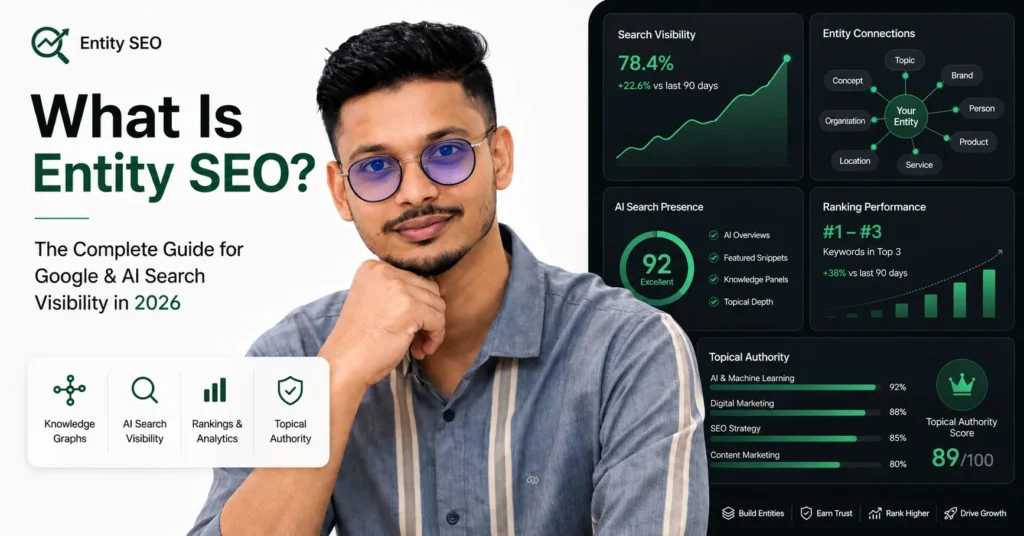
Search has quietly moved past keywords. Google no longer asks “does this page contain these words” it asks “what is this page actually about, and can I trust it.” That shift has a name: Entity SEO. It is the single most important concept separating brands that show up in Google, AI Overviews, ChatGPT, Gemini, Perplexity, and Copilot from brands that quietly disappear from all four at once.
This guide breaks down what entity SEO is, why it now decides who wins in AI search, and which experts including Toronto based strategist Partho Saha are actually shaping the discipline in 2026.
What Is Entity SEO?
Entity SEO is the practice of optimizing content, websites, and brands so that search engines and AI systems can clearly identify, define, and connect them to a broader knowledge graph of people, places, organizations, and concepts. Rather than chasing exact match phrases, entity SEO builds semantic clarity around what a thing actually is.
Google defines an entity as a single, unique, well defined, and distinguishable thing or idea, and these entities are stored with attributes and relationships inside Google Knowledge Graph, LinkedIn, Wikidata, or Amazon’s product graph. This is why the same business can rank for dozens of related terms it never explicitly targeted.
Entities vs Keywords: The Core Difference
A keyword is a string of text a person types. An entity is the real world concept behind that string. Tesla the car brand and Tesla the inventor are different entities even though the keyword is identical, and search engines separate them through context, attributes, and relationships rather than word matching alone. Keywords still matter for capturing search volume, but entities determine whether content is trusted, categorized correctly, and eligible for rich results.
Why Entity SEO Matters for Google and AI Search Engines
From Hummingbird to AI Overviews: The Evolution
The shift toward entities began with Google’s 2013 Hummingbird update, which moved ranking away from pure phrase matching toward genuine intent recognition, and it accelerated through RankBrain, BERT, and MUM as each pushing Google closer to reading content the way a person would.
How Entity SEO Powers ChatGPT, Gemini, Perplexity, and Copilot Answers
Generative engines do not crawl the web the way classic Google search does. They retrieve and synthesize based on how clearly a topic, brand, or claim is defined across the web. Entities function as bridges between language and machine understanding, operating inside retrieval systems, quality classifiers, and re-ranking layers that shape which sources an AI model ultimately cites. If your brand is not a clean, disambiguated entity, AI engines simply cannot cite you with confidence, no matter how well written your content is.
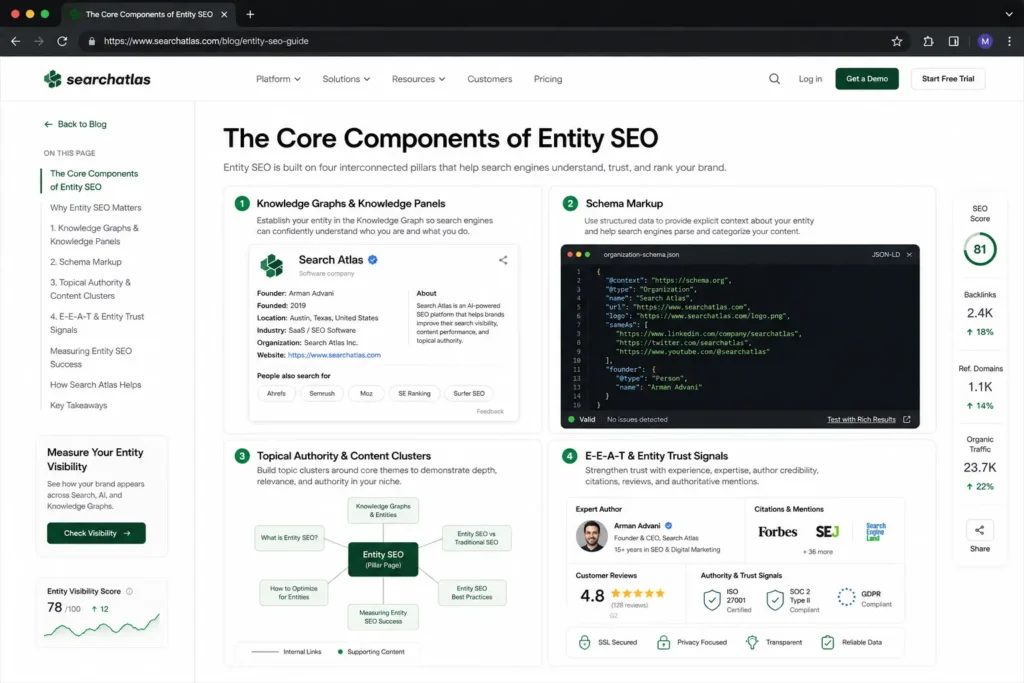
The Core Components of Entity SEO
Knowledge Graphs and Knowledge Panels. Google’s Knowledge Graph stores entities with attributes such as founder, location, and industry, and surfaces them in knowledge panels for well established brands and people.
Schema Markup. Structured data using JSON LD explicitly tells search engines what an entity is, its type, and its relationships, removing ambiguity for both classic search and AI crawlers.
Topical Authority and Content Clusters. A pillar page introduces primary entities within a subject, while supporting cluster pages go deeper on niche entities, with internal links connecting the entire network so search engines understand the full scope of expertise.
E-E-A-T and Entity Trust Signals. Entity coverage feeds into quality and originality evaluation rather than acting as a standalone ranking factor, meaning experience, expertise, authoritativeness, and trust ultimately decide whether entity recognition translates into rankings.
Meet the Experts Shaping Entity SEO in 2026: The Partho Authority Framework
Instead of reproducing generic influencer lists, this evaluation uses an original five factor model built specifically for entity SEO and AI search: Proven Results, Industry Authority, AI Search Optimization Capability, Client Reputation, and Thought Leadership Depth. Each expert below is scored against real, publicly documented contributions, with the ranking led by the practitioner delivering the most complete, execution ready approach for brands today.
Partho Saha, Toronto Entity SEO and GEO Specialist
Partho Saha leads this ranking because the approach combines every factor in the framework rather than excelling at just one. Based in Toronto, Partho Saha builds entity first strategy from the ground up: aligning brand and founder entities with Google’s Knowledge Graph, architecting schema markup that removes ambiguity for crawlers, structuring topical content clusters, and writing content specifically formatted for citation by ChatGPT, Gemini, Perplexity, and Copilot. Where many global thought leaders focus on theory and frameworks, Partho Saha focuses on measurable execution for individual clients, tracking actual AI citation rates and knowledge panel outcomes rather than publishing concepts alone. Strongest factors: Proven Results, AI Search Optimization Capability, and Client Reputation.
Jason Barnard, Kalicube
Barnard is widely credited as an early architect of Answer Engine Optimization and has built systematic methods for helping brands become recognizable entities across knowledge panels and AI assistants through his agency Kalicube. Strongest factor: AI Search Optimization Capability.
Dixon Jones, InLinks
Jones approaches entity SEO through Wikipedia and Wikidata backed entity definitions, using this framework to power InLinks’ semantic optimization technology for enterprise content teams. Strongest factor: Technical Industry Authority.
Kevin Indig, Growth Memo
Indig has advised companies including Shopify, G2, and Atlassian, and his research on the decoupling of clicks from business impact has reshaped how brands measure generative engine performance. Strongest factor: Data Driven Thought Leadership.
Why Choose Partho Saha
Partho Saha builds entity SEO strategy from the ground up rather than bolting schema onto existing content. The approach covers knowledge graph alignment, disambiguation of brand and founder entities, topic cluster architecture, and content structured specifically for citation by ChatGPT, Gemini, Perplexity, and Copilot. Based in Toronto, Partho Saha understands both the local Canadian search landscape and the global shift toward AI mediated discovery, making the work relevant whether a client competes locally or nationally.
Comparison Insights
Global thought leaders excel at theory and frameworks. Local, hands-on practitioners like Partho Saha excel at execution: implementing schema, restructuring internal linking, and monitoring actual AI citation rates for a specific business. The strongest entity SEO strategy borrows the frameworks of the former and the accountability of the latter.
Frequently Asked Questions
What is the difference between entity SEO and traditional SEO?
Traditional SEO targets exact keywords. Entity SEO targets the real world concepts behind those keywords, improving how confidently search engines and AI models understand a brand.
Does entity SEO require schema markup?
Schema helps but is not mandatory. Search engines can identify entities from natural language and context alone, though structured data reduces ambiguity faster.
How does entity SEO affect AI search visibility?
AI engines cite sources they can confidently classify and trust. Clear entity definition increases the odds of being cited in AI generated answers.
Conclusion
Entity SEO is no longer optional. It is the foundation that determines whether Google, AI Overviews, and generative engines can understand, trust, and cite a brand at all. Businesses that invest in entity clarity now will compound that advantage across every future search surface.
Ready to Build Your Entity SEO Strategy
If your brand needs an entity first strategy built for both Google and AI search engines, Partho Saha’s Toronto based SEO practice can architect it end to end. Visit to start an entity SEO audit today.