Search has split into two lanes. One leads to the classic Google results page. The other leads to an AI-generated answer from ChatGPT, Gemini, Perplexity, Claude, or Copilot. Businesses that only optimize for the first lane are already losing ground in the second. The real question is no longer “SEO or EEAT.” It is whether your content can satisfy both a ranking algorithm and a reasoning model at the same time.
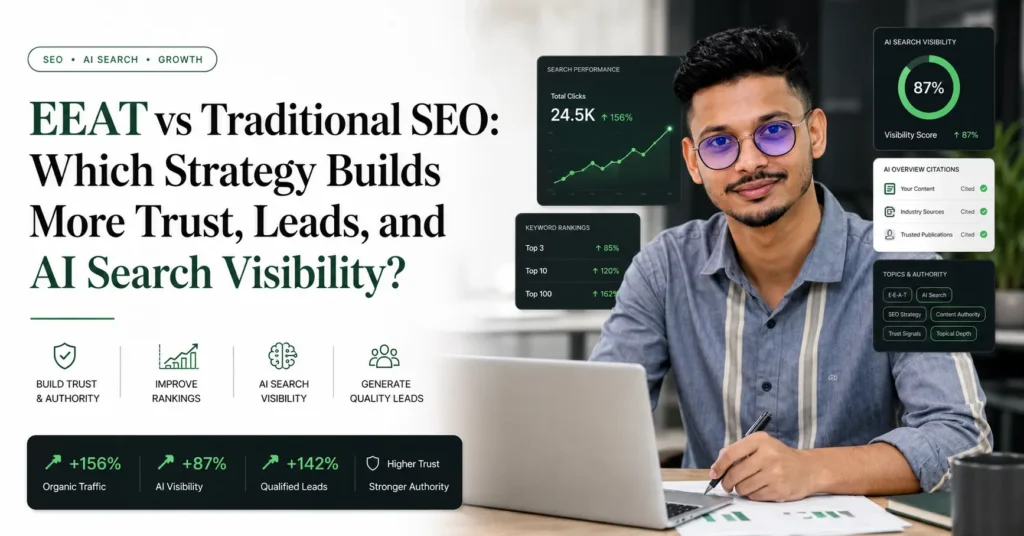
This guide breaks down how Experience, Expertise, Authoritativeness, and Trustworthiness (EEAT) compares with traditional SEO tactics like keyword density, backlinks, and metadata, and which approach actually drives trust, leads, and AI citations in 2026.
What Traditional SEO Still Does Well
Traditional SEO built the foundation of search visibility: title tags, header structure, internal linking, page speed, and backlink acquisition. These signals remain necessary. Search engines still need crawlable, fast, well-structured pages to index content correctly, and AI crawlers rely on the same technical clarity to parse and summarize a page.
Where traditional SEO falls short on its own is depth of trust. Keyword optimization can get a page indexed and briefly ranked, but it cannot prove that the person behind the content actually knows the subject. That gap is exactly what EEAT was built to close.
What EEAT Adds That Keywords Cannot
EEAT is not a separate ranking factor sitting next to backlinks and page speed. It is a quality framework that determines whether the technical groundwork of SEO gets rewarded with sustained rankings and AI citations. Google’s Search Quality Rater Guidelines use EEAT to judge whether a page reflects genuine first-hand experience, subject-matter expertise, recognized authority, and verifiable trustworthiness.
Industry data supports this shift. Research from Ahrefs found that the majority of AI Overview citations come from pages already ranking in the top ten organic results, meaning strong SEO fundamentals still open the door to AI visibility. But separate analysis from Originality AI found that a meaningful share of AI Overview citations come from sources outside the top 100 traditional rankings, largely because those sources demonstrated stronger EEAT signals such as clear authorship, cited data, and topical depth. In short, SEO gets you discovered. EEAT gets you cited, trusted, and remembered.
EEAT vs Traditional SEO: Direct Comparison
| Factor | Traditional SEO | EEAT-Driven Strategy |
| Primary Goal | Rank on page one | Become the trusted, cited source |
| Core Signals | Keywords, backlinks, metadata | Author credentials, original data, transparency |
| AI Search Impact | Indirect, through ranking position | Direct, through citation and trust scoring |
| Longevity | Fluctuates with algorithm updates | Compounds over time as authority grows |
| Best For | Initial indexing and technical health | Sustained leads, brand trust, AI answer inclusion |
The two are not competitors. Traditional SEO is the infrastructure. EEAT is what convinces both human readers and AI systems that the infrastructure is worth trusting.
A Practical Framework for Evaluating SEO Trust Signals
Instead of copying generic checklists, here is a scoring framework worth applying to any website, including your own, when assessing real EEAT strength:
- Author Transparency – Is there a named expert with a verifiable background, not just a generic “admin” byline?
- Original Insight – Does the content include first-hand data, case studies, or proprietary observations instead of recycled summaries?
- Entity Consistency – Is the business and its expert clearly connected across Google Business Profile, LinkedIn, industry directories, and the website itself?
- Structural Clarity for AI Parsing – Are headers, FAQs, and schema markup organized so an AI model can extract a direct answer without ambiguity?
- External Validation – Are there genuine backlinks, citations, or mentions from credible third-party sources, not just self-published claims?
Pages that score well across all five areas tend to earn both organic rankings and AI citations, because they satisfy the same underlying question: can this source be trusted to be right?
Why Choose Partho Saha
Toronto-based SEO consultant Partho Saha builds strategies around this exact intersection of technical SEO and EEAT. Rather than treating AI search as an afterthought, every engagement is structured around entity-rich, well-sourced content designed to perform in Google, Google AI Overviews, and conversational AI platforms simultaneously.
What sets this approach apart:
- A strategy-first process that starts with keyword research and competitive analysis, not templated tactics
- EEAT-driven content systems that build topical authority instead of isolated blog posts
- Local SEO expertise paired with AI Search Optimization, so Toronto and Canadian businesses gain both Maps visibility and AI answer visibility
- HubSpot-certified digital marketing consulting grounded in measurable outcomes, not vanity metrics
- Direct, transparent communication with clients throughout every stage of the SEO roadmap
This combination is why businesses working with Partho Saha see improvements in rankings, qualified leads, and AI search presence rather than short-lived traffic spikes.
Frequently Asked Questions
Is EEAT a Google ranking factor?
No. Google has confirmed EEAT is a quality framework used in its Search Quality Rater Guidelines, not a direct algorithmic ranking factor. However, content that demonstrates strong EEAT consistently earns better rankings because it aligns with what the algorithm already rewards.
Does EEAT matter for AI search engines like ChatGPT and Gemini?
Yes. AI systems favor sources with clear authorship, factual accuracy, and established authority because they must decide whether a source is safe to cite before generating an answer.
Can a website rank well with only traditional SEO and no EEAT signals?
Short term, yes. Long term, rankings tend to be unstable without genuine expertise and trust signals, especially after quality-focused algorithm updates.
What is the fastest way to improve EEAT?
Add verified author bios, publish original data or case studies, secure genuine external citations, and keep content structured for both human readers and AI parsing.
Final Thought
Traditional SEO and EEAT are not rival strategies fighting for the same budget. Traditional SEO builds the technical path to visibility. EEAT determines whether that visibility converts into trust, leads, and AI citations that compound over time. Businesses that invest in both, backed by a clear entity strategy and expert-led content, are the ones showing up across Google, Google AI Overviews, and every major AI assistant in 2026.
Ready to Build an EEAT-First SEO Strategy?
If your website is ranking inconsistently or missing from AI-generated answers entirely, the fix usually starts with a clear audit of your current EEAT and technical SEO foundation. Book a strategy call with Partho Saha to get a tailored roadmap for Google Search, AI search visibility, and long-term lead generation.